
Personal loans
Customized financing to consolidate high-interest debt and unlock financial flexibility.
WAYS TO USE YOUR LOAN
Resources
Guides, insights, and research – explore our latest articles.
About BHG
Programs
Debt Snowball vs. Avalanche: Which Repayment Strategy Is Best for You?
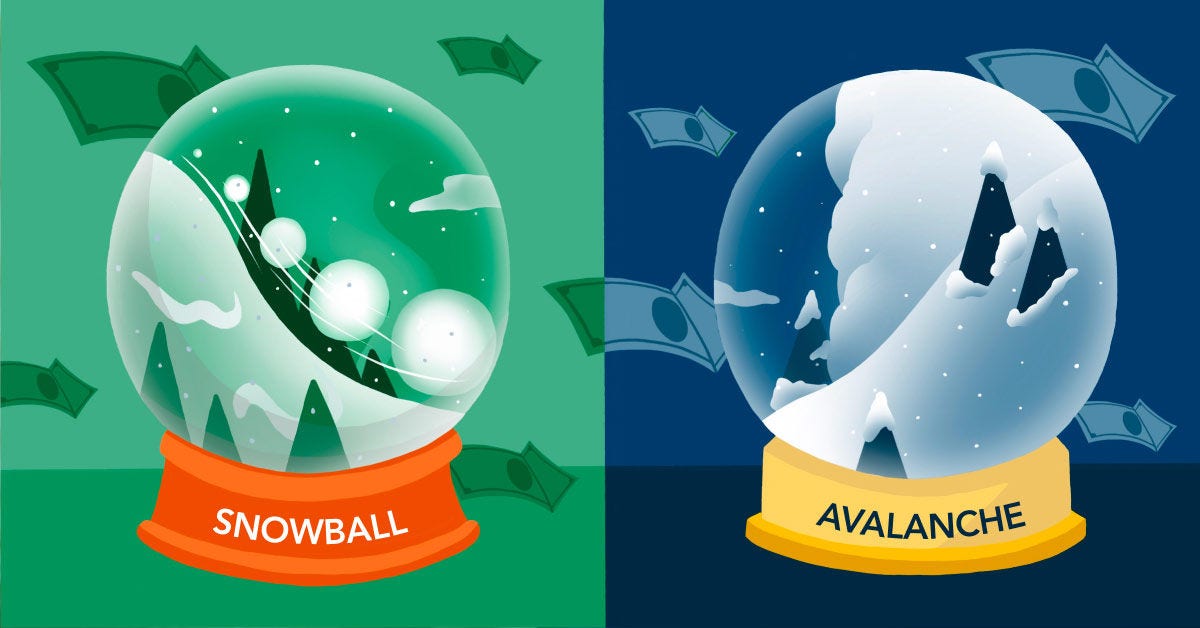
Table of Contents
- What are debt repayment strategies?
- What is the debt snowball strategy?
- What is the debt avalanche strategy?
- Comparing debt snowball vs. avalanche repayment strategies
- Choosing the best repayment strategy for your situation
- BHG as an alternative to debt snowball and avalanche payment methods
- Debt Snowball vs Avalanche FAQs
- Check my rate
Multiple debts mean multiple due dates, interest rates, and minimum payments. Even with a strong income, that’s a lot to manage. A repayment strategy, such as debt snowball or debt avalanche, gives you a clear plan of attack, so every extra dollar works harder for you.
With the snowball method, you target your smallest balance first, building confidence with quick wins along the way. The avalanche method takes the opposite route—targeting your highest interest rate first to save you more over time.
Below, we break down how each method works, where they differ, and how to choose the right one for your situation.
What are debt repayment strategies?
A debt repayment strategy is a plan for prioritizing and paying down multiple debts efficiently. The two primary debt repayment methods—snowball and avalanche—follow the same core principle: make minimum payments on every account and direct any extra funds toward one targeted balance at a time. Once that balance is cleared, roll the freed-up payment into the next one and repeat.
With the average American carrying $104,755 in debt, according to Experian, having a plan can help you save on interest, improve cash flow, and bring more predictability to your monthly budget.
What is the debt snowball strategy?
The debt snowball method targets your smallest balance first. You make minimum payments on all accounts, then put any extra amount toward the account with the smallest balance.
Once that’s paid off, you roll that extra amount into the next smallest balance—like a snowball picking up speed—and keep going until you’ve eliminated your debt.
Follow these steps to implement the debt snowball method:
- List your debts by balance (not interest), from smallest to largest.
- Make minimum payments on every account.
- Apply any extra funds to the smallest balance to pay it off as quickly as possible.
- When that debt is paid off, add the full payment amount to the account with the next lowest balance.
- Repeat until you’re debt-free.
Let’s take a look at how the debt snowball strategy plays out with an example.
Imagine you’re carrying the following debts and can put an extra $300 per month toward repayment:
|
Debt |
Balance |
APR |
Minimum payment |
|---|---|---|---|
|
Auto loan |
$18,000 |
4% |
$350 |
|
Credit card |
$28,000 |
22% |
$560 |
|
Personal loan |
$75,000 |
7% |
$1,200 |
Image is a representative example for illustrative purposes only and does not reflect actual customer information.
Your minimum payments total $2,110 per month. With the snowball method, you direct the extra $300 to the smallest balance first (the $18,000 auto loan), increasing that payment to $650 per month, while continuing to make minimum payments on the other debts.
Once the auto loan is paid off, that $650 is applied to the minimum of your next smallest balance, and then into the final debt.
In this case, you’d be debt-free in about 5.7 years, paying roughly $41,000 in total interest.
Debt snowball pros and cons
Popularized by personal finance expert Dave Ramsey, the debt snowball method is often the easiest to start and stick with, especially if you value visible progress and debt payoff momentum.
Pros:
- Quick wins that build motivation and confidence early
- Simple to set up and follow. Just rank your debts by balance and start with the smallest, no rate comparisons or spreadsheets required.
- A growing payment that accelerates progress with each payoff
Cons:
- You'll likely pay more in total interest, since you're not prioritizing your most expensive debt.
- It can take slightly longer to become fully debt-free, depending on how your balances and rates line up.
What is the debt avalanche strategy?
The debt avalanche method targets your debt with the highest interest rate first. You make minimum payments on all accounts, then put any extra amount toward the account with the highest interest rate.
Once that's paid off, you put the extra amount toward the next highest-rate balance and work your way down—creating an avalanche effect that gains momentum as each high-rate balance is eliminated.
- List your debts by interest rate, from highest to lowest.
- Make minimum payments on every account.
- Direct extra funds to the highest-rate debt.
- Once it's paid off, roll that larger payment to the account with the next highest rate.
- Repeat until you’re debt-free.
Now, let's see the debt avalanche method in action.
|
Debt |
Balance |
APR |
Minimum payment |
|---|---|---|---|
|
Credit card |
$28,000 |
22% |
$560 |
|
Personal loan |
$75,000 |
7% |
$1,200 |
|
Auto loan |
$18,000 |
4% |
$350 |
Image is a representative example for illustrative purposes only and does not reflect actual customer information.
Your total minimum payments are $2,110 per month, and you put $300 extra per month toward repayment.
With debt avalanche, you apply the extra $300 to the highest-interest balance first (the 22% credit card) bringing that payment to $860 per month.
Once that card is paid off, you take the $860 you were paying and apply that to the minimum of your next highest APR balance and repeat until you’re debt-free.
With this method, you’d be debt-free in about 5.4 years and pay roughly $34,000 in interest.
If you chose the snowball method instead, you’d end up paying about $7,000 more in interest and staying in debt for about three more months.
Debt avalanche pros and cons
The debt avalanche method is a strong fit for professionals who are comfortable tracking rates and staying disciplined, even when early progress feels slower.
Pros:
- Lower total interest, since you're eliminating the most expensive debt first
- A shorter payoff timeline in most scenarios
- Greater long-term savings, especially when rate differences are wide
Cons:
- Early progress can feel slow. If your highest-rate debt also has a large balance, it may take a while to see that first payoff.
- It requires more set up and discipline without the quick wins the debt snowball provides.
Comparing debt snowball vs. avalanche repayment strategies
Both strategies will help you become debt-free faster than making minimum payments alone. The difference is your goal: quick wins or lower total cost.
Here's how they compare:
|
Factor |
Debt snowball |
Debt avalanche |
|---|---|---|
|
Debt payoff order |
Smallest balance to largest |
Smallest balance to largest |
|
Motivation |
Strong early wins; visible progress |
Slower start; accelerates over time |
|
Interest savings |
Typically higher total interest paid |
Typically lowest total interest paid |
|
Ease of implementation |
Simple to follow |
Requires rate tracking and discipline |
Interest and total cost impact
In most cases, the debt avalanche method saves you more in interest because you eliminate the highest APR balance first.
Interest accrues on your remaining balance at your APR. The faster you reduce a high-rate balance, the less interest accrues over time. So, the avalanche is most advantageous when the interest rates are spread wide.
Timeline and payoff speed
If you're consistent with your extra payments, both debt snowball and avalanche can help you become debt-free on a similar timeline. The difference is often measured in months, not years.
The snowball can feel faster because you're closing out small balances early. You have fewer accounts, fewer payments, and a clear sense of forward motion.
The avalanche may feel slower at first, especially if your highest-rate debt has a big balance. But once that first major payoff hits, the freed-up payment makes the remaining debts fall quickly.
Psychological benefits and motivation
The debt snowball strategy works well if seeing progress helps you stay motivated. Settling an account is satisfying and may encourage you to stay on track with the repayment plan.
If you're motivated by efficiency, the debt avalanche method is a good choice. Knowing you're paying the least interest possible, even when the progress isn't as visible, can help keep you focused on your goal of being debt-free.
Practical considerations
Whichever repayment path you choose, consistency is the most important factor to success.
A few things to keep in mind:
- Always make minimum payments on every account: Missing one can trigger late fees and hurt your credit score.
- Check for prepayment penalties: Most credit cards don’t have them, but some personal loans do.
- Watch variable rates: A rate increase on one account could shift which debt deserves your attention first.
- Build a realistic budget: Know exactly how much “extra” you can commit each month. If your income varies, set a base amount and add occasional lump sums when cash flow allows.
Choosing the best repayment strategy for your situation
The right method depends on your financial profile and what keeps you motivated.
Here’s a quick guide:
- Choose snowball if early wins keep you engaged, you’ve struggled with consistency, or your debts carry similar interest rates. The snowball’s momentum makes it easier to build and maintain the habit of paying extra.
- Choose avalanche if your highest-rate debt is significantly above the rest and you’re committed to maximizing interest savings. If you’re comfortable with slower early progress in exchange for lower total cost, the avalanche is typically the better financial outcome.
- Consider a hybrid approach. There's no rule that says you have to pick one and stick with it forever. You can start with the snowball for a quick win or two, then switch to the avalanche to maximize savings, or vice versa.
BHG Financial as an alternative to debt snowball and avalanche payment methods
For high-income professionals managing debt across multiple accounts, consolidating those balances into a single fixed-rate loan can simplify repayment and potentially lower your total interest.
BHG Financial offers unsecured personal loans up to $250,0001 with terms up to 10 years.1,2 Prequalification uses a soft credit inquiry, so there's no impact on your score,3 and approval decisions can come in as little as 24 hours.4
Instead of juggling several due dates and rates, you get one predictable monthly payment and a clear payoff timeline. It's worth comparing whether debt consolidation would save you more than either repayment strategy on its own, especially if you can lock in a rate lower than what you're currently paying on most of your debts.
See your offer † real fast
Just a few easy steps to get prequalified!
† This is not a guaranteed offer of credit and is subject to credit approval.
Frequently asked questions
Is snowball or avalanche better for debt?
It depends on what keeps you motivated. The snowball builds momentum with quick wins, which helps if you need visible progress to stay consistent. The avalanche saves more on interest, making it the stronger financial choice when your debts have significantly different rates. Both are far better than making minimum payments alone.
What is the best debt payoff method?
The best method is the one you'll actually follow through. Snowball and avalanche are both effective repayment methods, but debt consolidation is also worth considering. If you're managing multiple high-interest balances, consolidation can simplify repayment into a single fixed monthly payment, often at a lower rate.
Which payoff strategy saves you money on interest?
The debt avalanche method typically saves you the most on interest because it eliminates your highest-rate debt first. The wider the gap between your highest and lowest interest rates, the bigger the savings. However, if your rates don’t vary widely, the difference between the two methods may be minimal.
Alternatively, consolidating your debt at a lower rate could potentially save more than either method.
How do I decide between snowball and avalanche debt payoff strategies?
Choose avalanche if your priority is minimizing interest; choose snowball if quick wins help you stick to the plan. You can also compare scenarios with a payoff calculator or consider debt consolidation if simplicity is your main goal.
Check my rate
See your offer † real fast
Just a few easy steps to get prequalified!
† This is not a guaranteed offer of credit and is subject to credit approval.
Not all solutions, loan amounts, rates or terms are available in all states.
1 Terms subject to credit approval upon completion of an application. Loan sizes, interest rates, and loan terms vary based on the applicant's credit profile. Not all applicants will qualify for the lowest rate.
2 Personal Loan Repayment Example: A $60,000 personal loan with a 7-year term and an APR of 17.06% would require 84 monthly payments of $1,191.38.
3 This is not a guaranteed offer of credit and is subject to credit approval.
4 There is no impact on your credit for applying. For personal loans, a complete credit history, which will appear as an inquiry on your credit report, will be performed upon acceptance and funding of the loan and may impact your credit.
No application fees, commitment, or impact on personal credit to estimate your payment.
Consumer loans funded by Pinnacle Bank, a Tennessee bank, or County Bank. Equal Housing Lenders. 
For California Residents: Personal loans made or arranged pursuant to a California Financing Law license - Number 603G493.

Bankers Healthcare Group, LLC d/b/a BHG Financial NMLS ID# 2040829