
Personal loans
Customized financing to consolidate high-interest debt and unlock financial flexibility.
About BHG
Programs
How AI Can Help High Earners Optimize Debt, Cash Flow, and Credit

Table of Contents
- What AI does better than traditional budgeting
- Step 1: Use AI to get a clear snapshot of your debt
- Step 2: Let it model a debt consolidation scenario
- Step 3: Use AI to improve credit optimization
- Step 4: Use AI-powered budgeting tools for long-term cash flow optimization
- Step 5: Automate smarter financial reviews
- What to do when AI reveals financial inefficiencies
- Using AI wisely: Where caution matters
- Final takeaway: AI makes optimization faster, not automatic
- Check my rate
Chances are, you’re not careless with money. You likely review transactions. You may use a budgeting app or maintain a spreadsheet. You understand where your income goes. But if cash flow feels tighter than expected, or you’re carrying significant debt, you’ve probably wondered whether restructuring your finances could create more control and flexibility.
AI has earned a reputation for cutting through complexity. The same technology that organizes massive datasets can also organize your debt structure. With the right inputs, it can quantify interest exposure, compare payoff strategies, and stress-test consolidation before you commit.
For high earners managing layered financial lives, that clarity can mark the difference between reacting to pressure and moving with intention.
What AI does better than traditional budgeting
Traditional budgeting, while useful, is inherently backward-looking. It tells you what happened last month. It rarely shows how today’s structure affects next year’s flexibility.
AI changes the vantage point. Instead of simply logging expenses, it analyzes patterns across accounts and stress tests decisions before you make them. It can highlight how variable compensation affects cash flow stability, identify where interest is compounding fastest, and translate complex financial data into clearer summaries.
You don’t need more data. You need a better perspective.
Real-time cash flow analysis
AI excels at organizing complexity. Upload a spreadsheet or transaction history, and it can automatically categorize activity into meaningful buckets:
- Debt obligations: Credit cards, installment loans, lines of credit
- Fixed expenses: Mortgage or rent, insurance, utilities
- Variable essentials: Groceries, fuel, childcare
- Discretionary spending: Dining, travel, subscriptions
From there, it identifies patterns. Maybe dining spikes during travel-heavy months. Maybe quarterly tax payments overlap with annual insurance renewals.
More importantly, it can forecast shortfalls.
Imagine uploading a 12-month expense sheet that includes a $20,000 annual property tax payment in December and quarterly estimated tax payments in April, June, September, and January. AI can project that December liquidity tightens significantly—months before you feel it—because two large obligations collide.
That bird’s-eye view matters. Especially when studies continue to show that many high-income households report feeling stretched despite strong earnings. Often, the issue isn’t income. It’s timing and structure. Seeing the full picture is often the first step toward regaining control.
Interest cost modeling
Over time, interest can become one of the largest drags on monthly cash flow. With credit card APRs frequently hovering above 20% in recent years, compounding accelerates quickly. A hefty revolving balance at elevated rates can quietly accrue tens of thousands of dollars in interest over time. The cost steadily absorbs liquidity that could be invested or preserved.
AI can help put this into perspective by calculating:
- Total projected interest if only minimum payments are made
- Blended interest rate across all accounts
- Interest paid over three, five, or seven years
- Comparative outcomes under different payoff strategies
AI can also compare payoff strategies. Should you target the highest rate first? Increase your monthly payments? Would consolidation lower total cost?
Instead of guessing, AI models the scenarios side by side, so you can begin formulating next steps.
Credit impact projections
Improved structure doesn’t just affect cash flow. It can influence borrowing power. Debt management often correlates with credit optimization.
Credit utilization—the percentage of available revolving credit you’re currently using—makes up a meaningful portion of a FICO score. Generally, keeping utilization below 30% is considered healthy.
If total credit limits equal $100,000 and total balances equal $45,000, your utilization is 45%. Even with strong income, that elevated ratio can weigh on a profile.
AI can:
- Model how paying down balances affects utilization ratios
- Simulate shifting from revolving credit to an installment loan
- Explain how certain actions might influence credit improvements over time
For example, consolidating multiple credit cards into a single fixed installment loan may substantially reduce revolving utilization, even if your income never changes. Over time, lower utilization combined with consistent payments can strengthen borrowing power.
Step 1: Use AI to get a clear snapshot of your debt
Before restructuring anything, start with a clean picture.
AI can only analyze what you provide. Optimizing your finances with its help requires complete and organized inputs (known as prompts). Think of this as building the foundation before adjusting the structure.
The better the data, the more reliable the modeling.
Tools you can use
Most major AI platforms offer a free version to anyone with an account, which is usually all you need for basic financial guidance. Here are some popular options:
- ChatGPT: free tier available; paid tiers start at $20 per month
- Google Gemini: free with a Google account; paid tiers around $29.99 per month
- Claude: free tier with Pro option around $20 per month
- Spreadsheets + AI: Excel with Copilot or Google Sheets with Gemini
That said, the tool matters less than the input you give it. AI platforms produce better results when prompts are detailed, specific, and complete. Vague data leads to vague conclusions.
What to prepare before you start
The more context you provide, the more accurate the analysis becomes. Gather:
- Current balances: all revolving and installment accounts
- Interest rates: fixed or variable
- Minimum payments: required monthly amounts
- Credit limits: for revolving accounts
- Monthly income: base salary plus bonuses or variable compensation
Copy-and-paste prompt to analyze your debt
Once your information is organized, you can move from observation to modeling. The goal is to have AI calculate exposure, quantify tradeoffs, and suggest a structured path forward.
Here’s a sample prompt:
I am a high-income earner evaluating my debt structure to optimize it.
Please analyze my total interest exposure, calculate my blended interest rate, estimate total lifetime interest if I make only minimum payments, and recommend a prioritized payoff strategy.
My details:
Credit Card 1: Balance $12,000, APR 18%, minimum payment $300, credit limit $30,000
Credit Card 2: Balance $8,000, APR 20%, minimum $213, credit limit $25,000
Personal Loan: Balance $25,000, APR 14%, monthly payment $581, remaining term 5 years
Other Debt: Zero
Monthly gross income: $12,000
Monthly net income: $9,000
Fixed monthly expenses (excluding debt): $6,500
Please calculate:
- Total monthly debt payments
- Blended interest rate across all debts
- Total projected interest over time
- Recommended order of repayment
- Whether consolidation into a lower-rate fixed loan could reduce total cost and improve cash flow
In this example, AI identified approximately $1,406 in monthly surplus cash flow that could be used to accelerate repayment.
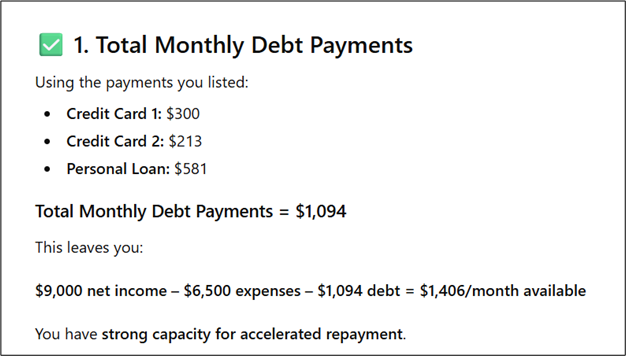
Screenshot from ChatGPT. Source: BHG Financial
It also clarified which balances were costing the most and suggested a repayment plan that reduces long-term interest exposure.
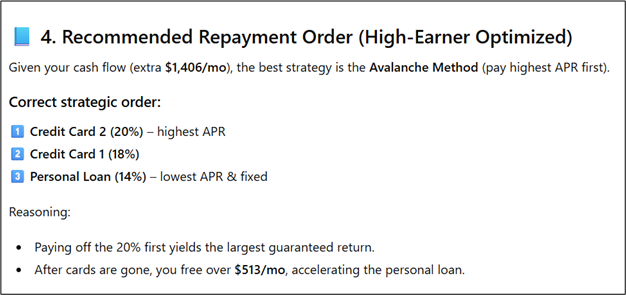
Screenshot from ChatGPT. Source: BHG Financial
Step 2: Let it model a debt consolidation scenario
If the initial analysis suggests inefficiencies, the next step is modeling alternatives. In the prompt above, the tool suggested paying off the highest rate debt to reduce long-term interest costs (the avalanche method). While this payoff method could work, you also have other options—especially since your existing APRs are so high. Pursuing debt consolidation could unlock additional savings and accelerate the payoff timeline.
Instead of guessing whether consolidation helps, AI can simulate it in seconds.
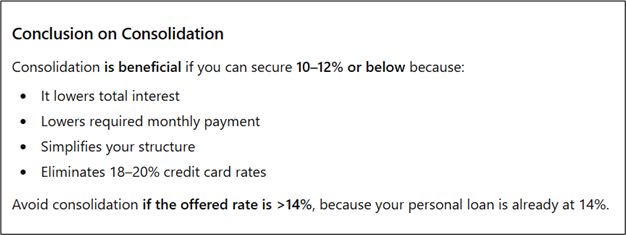
Screenshot from ChatGPT. Source: BHG Financial
Copy-and-paste consolidation comparison prompt
AI needs context and specific direction to produce helpful results, so consider including a sample debt consolidation loan “offer” to model your finances against.
For example:
Based on the debt details I shared above, assume I qualify for a $50,000 personal debt consolidation loan at 10% interest for 7 years.
Please compare:
- My current total projected interest cost
- My total interest cost under consolidation
- The monthly payment difference
- Break-even timeline
- Overall impact on my cash flow and liquidity
Then, tell me whether consolidation improves my financial position mathematically.
Within seconds, you have a side-by-side comparison. If the numbers show reduced interest drag and stronger cash flow control, the strategy becomes clearer.
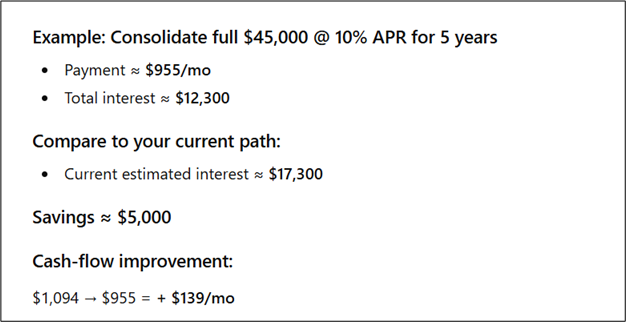
Screenshot from ChatGPT. Source: BHG Financial
FYI: Structured personal loans for debt consolidation—like those offered by BHG Financial—can combine multiple high-interest balances into one fixed monthly payment. That simplicity makes modeling easier and long-term planning more predictable.
See your offer † real fast
Just a few easy steps to get prequalified!
† This is not a guaranteed offer of credit and is subject to credit approval.
Step 3: Use AI to improve credit optimization
Interest affects cash flow. Credit affects flexibility. Optimizing finances often means improving both. As you evaluate restructuring options, it’s worth examining how those changes influence your borrowing profile.
Key metric to analyze: credit utilization
One benefit of debt consolidation is that it can lower your utilization rate. AI can explain utilization thresholds, model reductions, and estimate how shifting balances to an installment loan might change your profile.
Try this:
If I move from carrying $50,000 across revolving credit lines to a single $40,000 installment loan, such as a debt consolidation loan, how might that reduce my revolving balances? Also, share how that could impact my credit profile over time. Please explain the short-term and long-term effects.
This creates a clearer link between restructuring debt and strengthening your borrowing position.
Step 4: Use AI-powered budgeting tools for long-term cash flow optimization
Restructuring debt is a meaningful step, but sustaining progress requires developing responsible money habits and systems to avoid accumulating debt again. Structure supports momentum.
AI-powered budgeting tools help maintain discipline by forecasting cash flow, tracking trends, and quantifying progress.
AI budgeting tools to consider
|
Tool |
Cost |
What it does |
|---|---|---|
|
YNAB (You Need A Budget) |
~$14.99/month |
Cash flow forecasting |
|
Copilot Money |
~$13/month |
AI-driven categorization and net worth tracking |
|
Monarch Money |
~$14.99/month |
Multi-account cash flow and forecasting |
|
Rocket Money (Premium) |
~$7–$14/month |
Subscription tracking and optimization |
|
Tiller (Spreadsheet automation) |
~$79/year |
AI-ready Google Sheets automation |
Sources: YNAB, Copilot Money; Monarch Money; Rocket Money; Tiller
What to look for in these tools
- Monthly cash flow forecasting: Projects future account balances so pressure points appear early rather than unexpectedly.
- Category trend analysis: Highlights rising costs over time, helping you identify gradual expense creep.
- Subscription detection: Flags recurring charges that often blend into larger spending categories.
- Net interest tracking: Quantifies the real cost of carrying balances across accounts.
- Debt payoff projections: Visual timelines that show how additional payments accelerate freedom.
Step 5: Automate smarter financial reviews
Optimization isn’t a one-time event. Income changes. Markets shift. Goals evolve. A monthly AI-assisted review keeps your plan aligned with reality. Instead of revisiting your finances only when pressure builds, you create a consistent rhythm of evaluation and adjustment.
Monthly AI financial check-in prompt
Use a version of the following prompt monthly to gauge your process:
Here is my updated financial snapshot (balances, income, expenses). Tell me:
- Has my debt-to-income ratio improved?
- Am I overexposed to revolving credit?
- Should I accelerate payoff or preserve liquidity?
- Are there restructuring opportunities I should consider?
Over time, this becomes a financial optimization dashboard you can refer to regularly.
What to do when AI reveals financial inefficiencies
Insight is only step one. AI can diagnose inefficiency—but restructuring requires action. If AI surfaces elevated blended rates, heavy revolving exposure, overlapping payments, or substantial lifetime interest costs, that signals room for refinement.
For example, if modeling shows that consolidating balances reduces total interest and simplifies repayment, a structured debt consolidation loan—such as those offered by BHG Financial—may help streamline repayment and create greater payment predictability.
Look at the whole picture
Take what AI has surfaced and zoom out before implementing any change. When considering consolidation, for example, focus on total cost over time, not just on monthly payment reductions. Factor in potential loan fees, origination costs, and term length. Prioritizing lenders with repayment flexibility can help ensure you choose the best optimization strategy for your budget, timeline, and long-term goals.
See your offer † real fast
Just a few easy steps to get prequalified!
† This is not a guaranteed offer of credit and is subject to credit approval.
Using AI wisely: Where caution matters
AI is a powerful tool, but it isn’t perfect. Used thoughtfully, it accelerates clarity. Used carelessly, it can distort conclusions.
Provide full debt details
Incomplete data leads to distorted conclusions. Provide balances, rates, limits, and income context. The quality of what you get from AI-powered apps is proportional to the quality of the information you provide.
Use AI for advice, not as the final authority
AI assistants can generate useful projections, but they can also make mistakes or rely on outdated assumptions. Always double-check financial tips before acting on them. AI can miscalculate. Verify outputs. Double-check APR assumptions. And confirm loan terms with a reputable financial institution before making decisions.
Think of AI as an analytical assistant you leverage for insight. While AI-powered apps can help clarify, they shouldn't replace human judgment or take the place of advisors and reputable lenders with teams of experts who can provide tailored advice (like BHG Financial).
Final takeaway: AI makes optimization faster, not automatic
High earners often benefit most from structure—but structure can be difficult to see clearly when balances, payments, and goals overlap. AI helps reduce decision friction by clarifying tradeoffs and surfacing inefficiencies quickly.
If your modeling indicates that consolidation improves your numbers, exploring structured debt consolidation options may be a practical next step.
Ready to see what’s possible? Use BHG Financial’s quick and easy payment estimator to get your personalized loan estimate in just seconds.1
Check my rate
See your offer † real fast
Just a few easy steps to get prequalified!
† This is not a guaranteed offer of credit and is subject to credit approval.
Not all solutions, loan amounts, rates or terms are available in all states.
1 This is not a guaranteed offer of credit and is subject to credit approval.
Consumer loans funded by Pinnacle Bank, a Tennessee bank, or County Bank. Equal Housing Lenders. 
No application fees, commitment, or impact on personal credit to estimate your payment.
For California Residents: Personal loans made or arranged pursuant to a California Financing Law license - Number 603G493.

Bankers Healthcare Group, LLC d/b/a BHG Financial NMLS ID# 2040829