
Personal loans
Customized financing to consolidate high-interest debt and unlock financial flexibility.
About BHG
Programs
Using Debt Consolidation to Improve Cash Flow During High-Tax Years
Table of Contents
- Why high-tax years can create cash flow challenges
- What is debt consolidation and how does it work?
- Improve cash flow during tax season
- When debt consolidation makes sense in a high-tax year
- Using a BHG personal loan for debt consolidation
- Smart financial moves to pair with debt consolidation
- Final thoughts: Improving cash flow beyond tax season
- Check my rate
High-tax years often follow good news, such as a bonus, an increase in passive income, or an asset sold as a gain.
The new revenue is welcome, but the resulting tax bill may not be. When that tax liability comes due alongside ongoing debt payments, cash flow can feel far more constrained than expected.
Debt consolidation can help restore balance during these moments by simplifying payments, stabilizing cash flow, and giving you more control over timing—a critical factor during tax-heavy years.
Below, we break down why high-tax years create strain, how debt consolidation works, and when it can make sense as part of a proactive strategy for high-earning professionals navigating complex finances.
Why high-tax years can create cash flow challenges
High-tax years are often the result of intentional financial progress. Selling a home, earning more, expanding income streams—these are positive moves.
The challenge is that higher earnings and realized gains trigger higher taxes, and those taxes often come due at times when cash flow is already committed. If you’re also carrying ongoing debt obligations, that pressure adds up quickly.
This tension is especially common when much of your wealth is allocated toward investments, retirement accounts, or long-term assets that aren’t meant to be tapped for short-term needs. Things might look strong on paper but feel far tighter than expected month to month.
Common reasons for higher-than-expected tax bills
Several familiar scenarios can drive tax liability higher than anticipated:
- Income increases: Bonuses, commissions, overtime, or profit distributions can push income into higher marginal tax brackets, increasing the tax due on money earned.
- Uneven or supplemental income: Consulting work or side businesses with variable incomes can make automatic withholding harder to predict and increase the likelihood of underpayment during the year.
- Life changes: Marriage, divorce, dependents aging out of credits, or selling a home can change filing status, deduction eligibility, or bracket thresholds midyear.
- Outdated withholding elections: W-4s that haven’t been revisited in years may no longer reflect current income or household structure.
The impact of taxes on monthly cash flow
Taxes are typically paid in lump sums. Most budgets operate on monthly rhythms.
When a large tax payment coincides with significant monthly debt payments, cash flow constraints follow. Credit card minimums may increase as balances carry forward, and variable rates complicate planning. As a result, savings intended for other priorities often get redirected to cover gaps.
That strain isn’t just financial. Layering tax pressure on top of debt increases mental load and financial anxiety. This is usually when planning is postponed, and short-term decisions crowd out longer-term goals.
Read more: High Income, Low Growth? The Surprising Reason Your Wealth Isn’t Scaling
What is debt consolidation and how does it work?
Debt consolidation is simple by design. When used intentionally, it can serve as a stabilizing force during periods of tight cash flow.
Debt consolidation explained
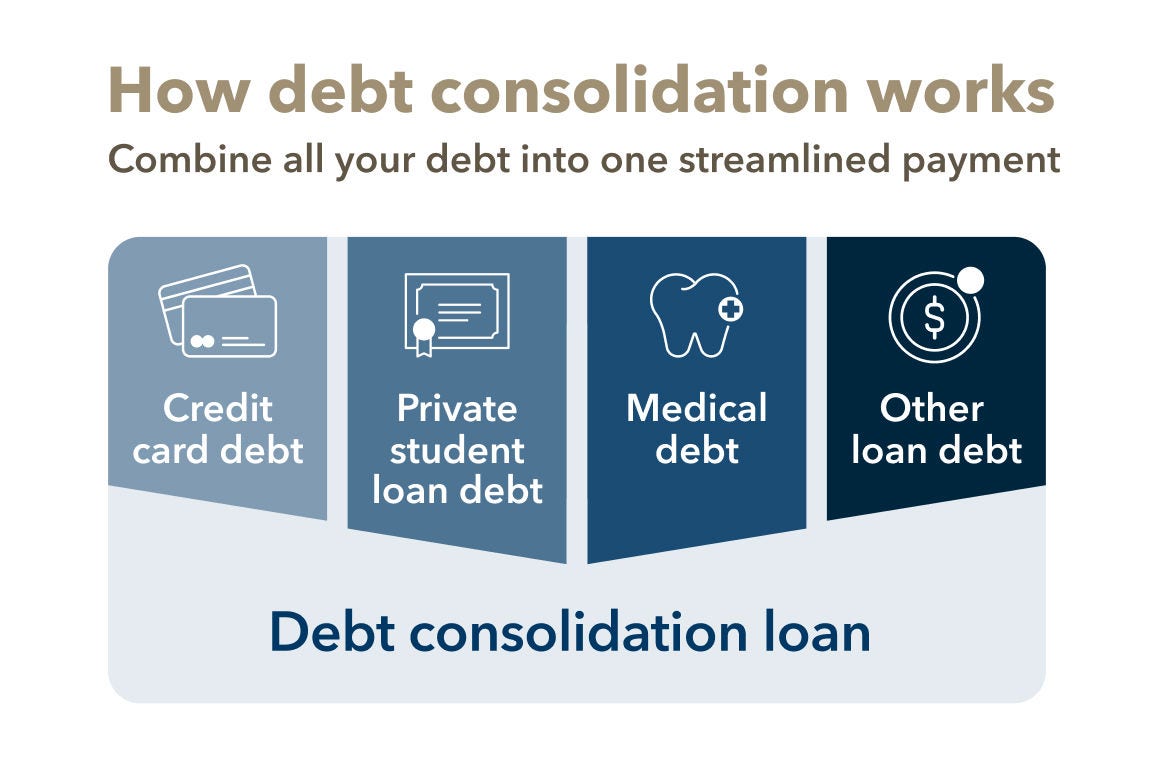
Debt consolidation combines multiple existing debts into a single loan. Instead of juggling several balances, interest rates, and due dates, you replace them with:
- One loan
- One fixed monthly payment
- One defined payoff timeline
For borrowers carrying high-interest revolving balances, consolidation often improves cash flow immediately. Payments become predictable, and overall interest costs may be reduced.
Types of debt commonly consolidated
Debt consolidation loans are most often used for unsecured obligations, including:
- Credit cards: Especially balances with double-digit APRs and varying minimums
- Existing personal loans: Short-term loans with high monthly payments
- Medical bills: Balances that disrupt cash flow, even when interest is deferred
- Education loans or other high-interest unsecured debt
How debt consolidation can improve cash flow during tax season
Debt consolidation improves cash flow by restoring control. Predictable payments reduce friction, freeing up dollars that can be redirected toward taxes, savings, or personal goals that were previously on hold.
Lower monthly payments
Consolidation often lowers monthly payments by replacing high-interest balances with a longer-term, fixed-rate loan. That shift can:
- Provide funds to cover tax payments without draining reserves
- Reduce reliance on revolving credit during high-expense periods
- Create flexibility to adjust withholding or estimated payments going forward
For example, consolidating several credit cards with escalating minimums into one structured loan can immediately stabilize monthly obligations during tax season.
Predictable payments during a financially stressful time
Credit card payments fluctuate. Loan payments don’t.
Fixed monthly payments make budgeting easier when taxes are already consuming mental bandwidth. Knowing exactly what’s due—and when—allows you to allocate cash deliberately instead of reacting month to month.
That consistency is especially valuable for professionals with uneven income, commission-based compensation, or seasonal earnings.
Read more: Tax Implications of Debt Consolidation: What High-Credit Consumers Need to Know
Simplify your debt
Get prequalified fast and see your personal loan offers †
† This is not a guaranteed offer of credit and is subject to credit approval.
When debt consolidation makes sense in a high-tax year
Think of consolidation as a structural reset. It’s not a cure-all, but a practical tool that works best when used with intention.
Signs you may benefit from consolidation
You may want to explore consolidation if you recognize these patterns:
- You're carrying high credit card balances even though your income is strong
- You're making consistent payments but struggling to reduce principal
- You’re using savings earmarked for retirement or tax refunds to cover monthly obligations
- You feel constrained during tax season despite earning well
These signals often point to a cash-flow mismatch rather than a spending problem. It’s worth noting that liquidity stress can occur outside tax time as well: an unexpected bill hits, you begin caring for aging parents and children, or income varies. In these instances, consolidation can help restore liquidity and streamline finances.
See what a fixed-rate loan could do for you
Let us help you compare personal loan options fast
Situations where caution is needed
For consolidation to be effective, it needs guardrails.
Prioritize unsecured consolidation options, so you’re not putting hard-earned assets at risk. Prequalify with lenders (like BHG Financial) that offer repayment flexibility, so you can explore loan options and choose a repayment term that fits comfortably within your budget, even in higher-tax years.
Then, pair the loan with a clear post-consolidation plan to avoid reaccumulating balances. This ensures you simplify and stabilize your finances rather than shift the pressure elsewhere.
Using a BHG personal loan for debt consolidation
If high-interest debt is limiting your ability to handle an impending tax bill—or make strategic financial moves afterward—consolidation can serve as a practical reset. A BHG personal loan for debt consolidation replaces multiple high-interest balances with a single fixed-rate structure designed to improve cash flow.
How BHG personal loans support cash flow goals
BHG personal loans are designed for borrowers managing complex financial lives. Key features include:
- One fixed monthly payment that’s easy to plan around.
- Competitive fixed rates compared to most revolving credit.
- Extended terms1 that reduce monthly pressure during high-tax or high-expense years.
Because BHG specializes in larger unsecured loans, up to $250,000,1 qualified borrowers can consolidate all or most balances at once. That means fewer leftover payments competing with tax obligations.
See your offer † real fast
Just a few easy steps to get prequalified!
† This is not a guaranteed offer of credit and is subject to credit approval.
Smart financial moves to pair with debt consolidation
Debt consolidation works best as part of a coordinated approach, especially in high-tax years.
Adjusting withholding or estimated tax payments
A higher tax bill often signals it’s time for a deeper financial review. As income rises, marginal tax rates tend to rise with it. Adjusting tax payments can prevent future tax surprises. For example:
- Withholding adjustments may help when income is steady but taxes withheld during the year haven’t kept pace with earnings. Updating elections can more evenly distribute tax responsibility across pay periods.
- Making estimated tax payments are often more effective for uneven income, self-employment, or capital gains, helping reduce large one-time payments at filing.
- Strategic itemizing can matter in high-income years where mortgage interest, SALT deductions, and charitable giving exceed the standard deduction.
Coordinating these decisions with a tax professional to ensure your debt strategy aligns with tax planning and any current legislation that may affect your personal circumstances.
Read more: High Income, High Taxes, High Interest: How to Prioritize Debt Paydown
Creating a post-tax-season cash flow plan
Once tax season passes, consolidation can support longer-term stability by helping you:
- Rebuild emergency savings
- Pay down principal faster when cash flow allows
- Reduce reliance on credit cards during future spikes
Shifting focus toward long-term wealth building
With debt payments stabilized and a plan in place, your attention can shift forward. Improved cash flow creates room to focus on compounding strategies that encourage wealth-building, such as:
- Funding IRAs or executing backdoor Roth strategies
- Maximizing 401(k) or profit-sharing contributions
- Contributing to health savings accounts (HSAs)
- Timing charitable giving or itemizing deductions
- Investing surplus cash tax-efficiently into high-yield savings accounts or the stock market
Final thoughts: Improving cash flow beyond tax season
High-tax years test even well-run financial plans. Debt consolidation can be a practical tool in those moments by simplifying payments, restoring predictability, and creating space to act intentionally rather than reactively.
When you’re ready to move through tax season—and the months that follow—with greater control and momentum, BHG Financial can help. Explore your personalized loan estimate and see how consolidation could support your cash flow during high-tax years.
Check my rate
See your offer † real fast
Just a few easy steps to get prequalified!
† This is not a guaranteed offer of credit and is subject to credit approval.
This article has been prepared for informational purposes only, and is not intended to provide, and should not be relied on for tax, legal or accounting advice. You should consult your own tax, legal and accounting advisers before taking any action(s).
Not all solutions, loan amounts, rates or terms are available in all states.
1 Terms subject to credit approval upon completion of an application. Loan sizes, interest rates, and loan terms vary based on the applicant's credit profile. Not all applicants will qualify for the lowest rate.
Consumer loans funded by Pinnacle Bank, a Tennessee bank, or County Bank. Equal Housing Lenders. 
No application fees, commitment, or impact on personal credit to estimate your payment.
For California Residents: Personal loans made or arranged pursuant to a California Financing Law license - Number 603G493.

Bankers Healthcare Group, LLC d/b/a BHG Financial NMLS ID# 2040829