
Personal loans
Customized financing to consolidate high-interest debt and unlock financial flexibility.
WAYS TO USE YOUR LOAN
Resources
Guides, insights, and research – explore our latest articles.
About BHG
Programs
$110,000 Personal Loan: Rates, Terms & Payments
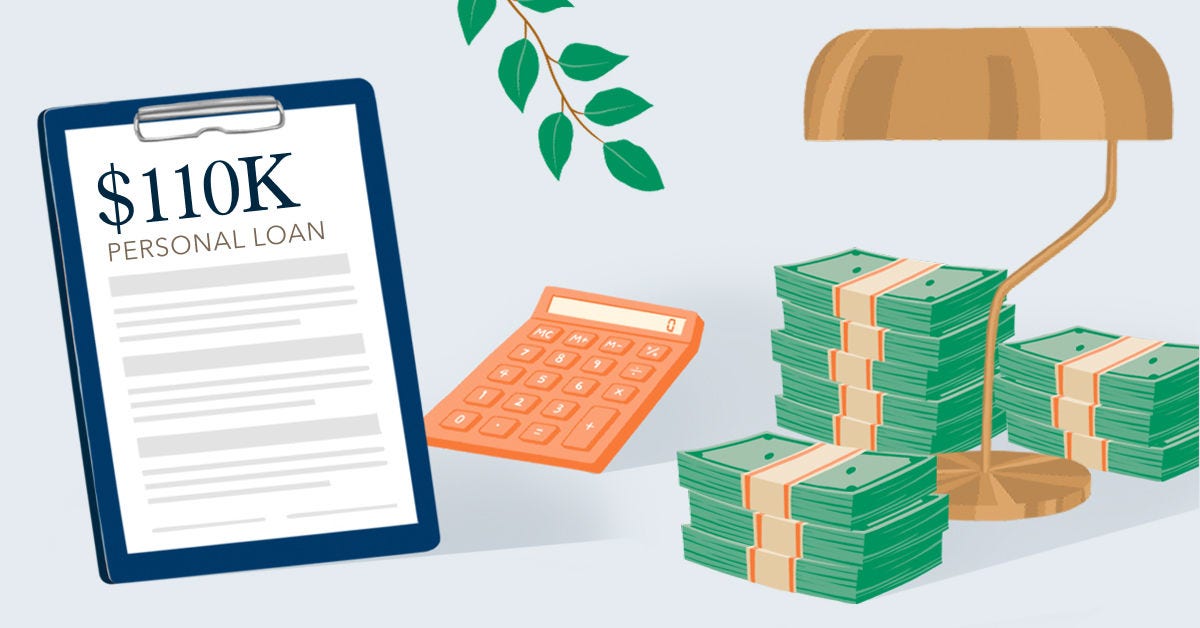
Whether you're considering a debt consolidation loan to consolidate high-interest debt, funding a major expense, or managing your cash flow, a $110,000 personal loan can be a flexible solution with predictable payments and no collateral required. But choosing the right lender and understanding affordability, costs, and eligibility will be important.
We’ll explain where and how to get a $110,000 loan, estimate payments and interest, and discuss alternatives so you can choose the best borrowing option for your goals.
Key takeaways
The right $110,000 personal loan can provide you with quick access to flexible funds with a competitive interest rate and a manageable monthly payment. You’ll typically only find these loans through high-limit lenders and need to have excellent credit, manageable existing debt, and a sufficient, verifiable income.
To find the right fit, compare the payments and total interest associated with multiple term options.
How does a $110,000 personal loan work?
A $110,000 personal loan provides a lump sum you can use for flexible purposes. It will typically have a fixed interest rate and require monthly payments that stay the same over the loan term, often between three and 10 years. Additionally, most $110,000 personal loans are unsecured, so you avoid putting an asset at risk to borrow funds.
These features make personal loans ideal when you need funds upfront and steady payments that align with your cash flow. But they’re also useful for borrowing money at a lower interest rate than some credit cards. The Federal Reserve reports national average rates of 20.97% for credit cards compared to 11.65% for personal loans.
See your offer † real fast
Just a few easy steps to get prequalified!
† This is not a guaranteed offer of credit and is subject to credit approval.
What are the monthly payments on a $110,000 loan?
Monthly payments on a $110,000 loan vary significantly based on your interest rate and repayment term. If you choose a longer term, you’ll have a lower monthly payment but pay more interest over the life of the loan. Shorter terms are ideal for reducing interest costs but require more room in your monthly budget.
The table below shows estimated monthly payments and interest costs for a $110,000 loan across three terms and hypothetical annual percentage rates (APRs):
|
|
3-year term |
5-year term |
7-year term |
|---|---|---|---|
|
8% APR |
$3,447/month |
$2,230/month |
$1,714/month |
|
12% APR |
$3,654/month |
$2,447/month |
$1,942/month |
|
18% APR |
$3,977/month |
$2,793/month |
$2,312/month |
Image is a representative example for illustrative purposes only and does not reflect actual customer information.
These examples show how significant the term's impact is on total interest costs. A $110,000 personal loan at 12% APR costs roughly $36,813 in interest over five years and $53,111 over seven years—a $16,298 difference.
Remember that these estimates are calculated using standard amortization with monthly compounding, rounded to the nearest dollar. Your actual rates and payments will depend on your credit profile, income, and lender terms.
How to get a $110,000 personal loan
Getting a $110,000 personal loan is pretty straightforward if you work with the right lender and meet the requirements for high-limit loans. Here are the steps to expect.
Understand lender options
A $110,000 personal loan is above what most lenders offer. Most banks, credit unions, and online lenders cap unsecured personal loans at $50,000 to $100,000. So, you’ll likely need to find a lender that specifically serves high-limit borrowers. BHG Financial offers large unsecured personal loans up to $250,0001 to qualified borrowers.
Assess your finances
Borrowing $110,000 will require a strong financial profile that gives lenders confidence you can repay that six-figure amount.
Here's what lenders typically look for:
- Excellent credit profile: Some lenders require a minimum credit score of 640, with higher scores generally associated with better rates and terms. They’ll also look for a clean payment history, free of recent defaults or bankruptcies.
- Strong, verifiable income: A loan of this size requires having a consistent, high income, often $100,000 or higher, and documentation to back it up. Many providers, including BHG Financial, will consider multiple income streams—such as W-2, investment, and business—and offer solutions if you have variable income.
- Manageable debt-to-income (DTI) ratio: Lenders often like to see a debt-to-income ratio (DTI) of 36% or less, though some will accept higher DTI ratios based on your income or credit profile. This metric is important to help you avoid taking on a monthly payment your cash flow can’t accommodate.
If your finances aren’t yet ready for a six-figure loan application, consider practical steps to address any credit issues, increase your verifiable income, or pay off debt that is driving up your DTI ratio.
Complete prequalification
Many lenders offer personal loan prequalification, which lets you see estimated rates, payment amounts, and terms without affecting your credit score. After you provide some initial personal and financial information, the lender will do a soft credit pull, with no hard pull needed until you officially apply. There’s no commitment involved.
Since prequalification is fast and easy, it’s wise to complete the process with at least a few lenders so that you have multiple offers to compare.
Choose the right lender and loan
Before officially applying for a $110,000 personal loan, carefully compare each lender and loan offer to figure out which best suits your needs.
When comparing loans, consider factors such as APRs, term options, monthly payments, and any additional fees. Reputation, funding timelines, and customer reviews are important to consider for lenders.
Submit your official application
The application experience at high-limit lenders is often efficient. Expect to provide extensive details on the official application and submit documentation.
Here’s what lenders often need to process your application:
- Proof of income: W-2s, 1099s, pay stubs, bank statements, and/or tax returns
- Proof of address: Utility bill, lease agreement, or mortgage statement
- Proof of identity: Driver’s license, state ID, or passport
Your lender will verify your information and documents and contact you if it has questions. At some point during the process, the lender will usually run a hard credit check, which may have a small, temporary impact on your credit score.
Receive your funds after approval
Approval times will depend on your lender. While one to two weeks is typical, decisions can come as soon as 24 hours. Once approved, you’ll typically have your $110,000 loan deposited into your bank account, sometimes in as few as five days.
Be sure to read your loan agreement and ask your lender any questions. You may also want to set up automatic payments on your new $110,000 personal loan.
$110,000 personal loan compared to alternatives
The best way to borrow $110,000 depends on what you own, how quickly you need funds, and how much risk you're comfortable with. The table below shows how an unsecured personal loan compares to two popular home equity products, which may be available if you have at least 15% to 20% equity and meet other lender qualifications.
|
Feature |
Unsecured personal loan |
Home equity line of credit (HELOC) |
Home equity loan |
|---|---|---|---|
|
Typical APR |
6%–36%+ |
Prime + margin (variable) |
5%–8%+ (fixed) |
|
Term length |
3–10 years |
5–10 years (draw); 10–20 years (repayment) |
15–30 years |
|
Collateral required |
No |
Yes (home) |
Yes (home) |
|
Funding speed |
A few days |
2–6 weeks (appraisal required) |
2–6 weeks (appraisal required) |
|
Payment type |
Typically fixed |
Variable during draw; fixed at repayment |
Typically fixed |
|
Documentation |
Streamlined |
Full mortgage underwriting |
Full mortgage underwriting |
Sources: Experian; Investopedia
Personal loan
Personal loans work best when you need funds quickly, don't want to put your home at risk, or prefer a fixed payment with a defined payoff date. The APR is typically higher than secured options, but the speed, simplicity, and lack of collateral are meaningful advantages for borrowers who qualify. The application process is also much more straightforward.
See your offer † real fast
Just a few easy steps to get prequalified!
† This is not a guaranteed offer of credit and is subject to credit approval.
HELOC
HELOCs compared to personal loans often offer lower initial rates, but the tradeoffs are less predictable payments and total interest costs.
During the draw period, you can borrow what you need from the credit line and pay only interest, which can feel manageable. But once the repayment phase begins, your payments can substantially increase and strain your cash flow. The Consumer Financial Protection Bureau also notes that variable interest rates can mean payments change as often as monthly.
Plus, your home secures the credit line, so missed payments carry real consequences, like potential foreclosure. Also, keep in mind that the long application process can take several weeks to complete, and closing costs may apply.
Home equity loan
Since term options are usually long, a home equity loan can deliver the lowest monthly payment when you need to borrow $110,000. It also tends to offer better rates than personal loans, and those rates are usually fixed for similar predictability.
However, home equity loans share some drawbacks with HELOCs, including a longer underwriting timeline, the risks of using your home as collateral, and closing costs that add to your upfront costs.
If you already have a low rate on your first mortgage, tapping equity through a second lien may be more efficient than refinancing the entire balance with a cash-out refinance. But this personal loan alternative isn’t ideal for quick funds without collateral risk.
What are the costs that come with a $110,000 loan?
When comparing options for a $110,000 loan, account for these potential costs:
- APR: This is the most accurate way to compare loan costs across products. Unlike a nominal interest rate, the APR includes fees in its calculation, giving you a truer picture of what you're paying.
- Origination fees: For personal loans, origination fees are common and typically range from 1% to 10% of the loan amount. On a $110,000 loan, that's a meaningful difference in what you actually receive versus what you owe.
- Closing costs: For mortgage and home equity products, closing costs typically run 2%–5% of the loan amount. If you borrow $110,000, that's $2,200–$5,500 in upfront costs before you make a single payment. Points, appraisal fees, title insurance, and escrow setup all contribute to that range.
Get a $110,0001 loan through BHG Financial
BHG Financial specializes in helping six-figure earners access high-limit loans of up to $250,0001 with extended terms up to 10 years.1,2 Our unsecured personal loans feature fixed rates and predictable payments that align with personal cash flow needs. Our flexible solutions allow you to access funds, preserve liquidity, and avoid the risk of pledging collateral.
When considering borrowers for personal loans of $100,000, BHG looks at the whole financial picture, including multiple income streams, challenges, and goals. We also provide U.S.-based concierge support and require minimal documentation. If approved, you could get your $110,000 in as little as five days.3
Ready to see if we’re the right fit? Get a quick, no-obligation estimate today for a personalized offer.
Check my rate
See your offer † real fast
Just a few easy steps to get prequalified!
† This is not a guaranteed offer of credit and is subject to credit approval.
$110,000 personal loan FAQ
How much do you need to make to qualify for a $110,000 loan?
To qualify for a $110,000 loan, lenders focus on your DTI ratio, credit profile, and income stability. A common underwriting rule is that your total monthly debt payments divided by your total monthly income should fall within the lender’s DTI ratio limit. For mortgages, lenders also evaluate your housing payment compared to your income.
What affects $110,000 loan payments the most?
The biggest drivers of $110,000 loan payments are the APR and the loan term. A longer term lowers the monthly payment but increases total interest paid, while a shorter term raises the payment but reduces total interest. The loan type also matters. A mortgage payment may include taxes, insurance, and PMI, while a $110,000 personal loan may include origination fees and typically has different term lengths and pricing.
Recommended articles
Debt Consolidation
7 Key Factors That Determine Eligibility for High‑Limit Debt Consolidation Loans
January 12, 2026 | 7 min read

Personal Loans
How to Get a $100,000 Loan: Requirements, Rates, and Alternatives
May 23, 2025 | 8 min read

Personal Loans
Are Personal Loans a Good Idea for High Earners? What the Data Says
October 31, 2025 | 7 min read
Personal Loans
Should You Dip Into Savings or Use a Loan? How to Decide
October 14, 2025 | 6 min read
Debt Consolidation
When to Pay Credit Card Bill to Increase Credit Score
August 28, 2025 | 7 min read
Personal Loans
Personal Loan vs Credit Card: The Surprising Way to Cut Interest Costs
June 23, 2025 | 6 min read
Advertised rates are subject to change without notice.
Not all solutions, loan amounts, rates or terms are available in all states.
1 Terms subject to credit approval upon completion of an application. Loan sizes, interest rates, and loan terms vary based on the applicant's credit profile. Not all applicants will qualify for the lowest rate.
2 Personal Loan Repayment Example: A $60,000 personal loan with a 7-year term and an APR of 17.06% would require 84 monthly payments of $1,191.38.
3 This is not a guaranteed offer of credit and is subject to credit approval.
No application fees, commitment, or impact on personal credit to estimate your payment.
Consumer loans funded by Pinnacle Bank, a Tennessee bank, or County Bank. Equal Housing Lenders. 
For California Residents: Personal loans made or arranged pursuant to a California Financing Law license - Number 603G493.

Bankers Healthcare Group, LLC d/b/a BHG Financial NMLS ID# 2040829