
Personal loans
Customized financing to consolidate high-interest debt and unlock financial flexibility.
About BHG
Programs
$180,000 Personal Loan: Find a Large Loan with Fixed Rates
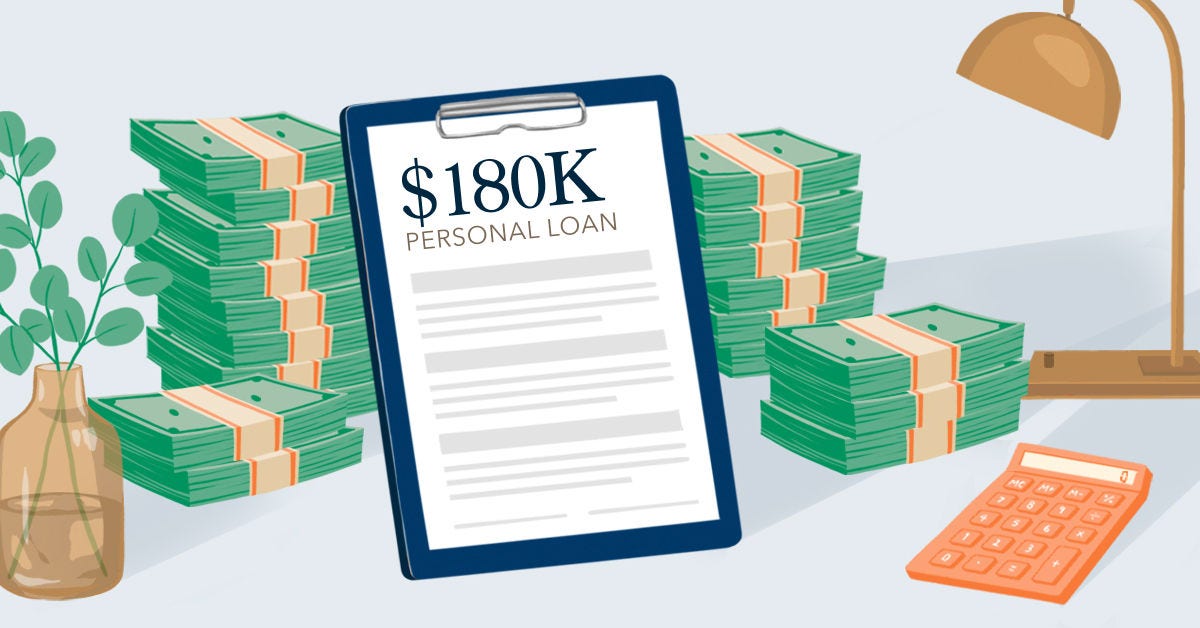
Whether you're borrowing funds for home repairs, a major purchase, or debt consolidation, a $180,000 personal loan offers flexible funding and predictability. However, most lenders cap unsecured personal loans at $50,000 to $100,000, so you'll need to find a high-limit lender and have good credit, a solid income, and manageable existing debts.
We’ll discuss where you can find a $180,000 personal loan, what your monthly payments might look like, how the total cost adds up, and whether you can qualify. You’ll also learn about popular alternatives to large unsecured personal loans.
Key takeaways
While $180,000 personal loans are uncommon, some specialty providers like BHG Financial offer them to qualifying borrowers. You’ll typically need a minimum credit score of 640, a maximum debt-to-income (DTI) ratio of 36%, and a high verifiable income. Prequalify with lenders to check your potential rate and payment amount, and choose a term that balances payment affordability with manageable interest.
What is a $180,000 personal loan?
A $180,000 personal loan is a large installment loan that is typically unsecured, meaning you don’t need to provide collateral. Lenders often offer fixed interest rates and require equal monthly payments paid over a set term, such as three to 10 years. The benefits are predictable monthly payments that align with your cash flow and clear interest costs.
Mainstream lenders, such as banks and credit unions, usually offer much smaller personal loan amounts. However, some online providers that serve high-income borrowers, such as BHG Financial, offer unsecured personal loans up to $250,000.1
Borrow more without collateral
Explore unsecured personal loan options up to $250K†
† Terms subject to credit approval upon completion of an application. Loan sizes, interest rates, and loan terms vary based on the applicant's credit profile. Not all applicants will qualify for the lowest rate.
What are the payments on a $180,000 personal loan?
The monthly payment on a $180,000 personal loan depends on your chosen term length and the annual percentage rate (APR) you qualify for based on your creditworthiness. In February 2026, the personal loan APRs averaged 11.40% per the Federal Reserve.
While your actual numbers may vary, the table below shows estimated monthly payments for a $180,000 personal loan across a few common terms and APRs.
|
APR |
3-year term |
5-year term |
7-year term |
10-year term |
|---|---|---|---|---|
|
12% |
$5,979 |
$4,004 |
$3,177 |
$2,583 |
|
20% |
$6,689 |
$4,769 |
$3,997 |
$3,479 |
|
28% |
$7,445 |
$5,604 |
$4,907 |
$4,481 |
Image is a representative example for illustrative purposes only and does not reflect actual customer information.
A longer term leads to a lower monthly payment, but it also increases the total interest paid over the loan term. At a 12% APR, stretching your loan from five years to 10 years cuts your monthly payment by roughly $1,400 but more than doubles the total interest paid.
Ultimately, the right term depends on your cash flow needs and how aggressively you want to pay down the balance. Running multiple scenarios to compare payments and total interest costs before you commit is worthwhile.
Can you qualify for a $180,000 personal loan?
A $180,000 unsecured personal loan sits at the upper edge of what most lenders will approve. So, qualifying requires a strong financial profile across several dimensions, not just a good credit score.
Credit history and score
Lenders offering high-limit unsecured loans typically require excellent credit. While a FICO score of 640 is a common minimum, borrowers who qualify for the most favorable APRs generally have scores of 720 or higher. A clean payment history and deep credit history, meaning a long history with a mix of account types, both help with approval.
If you have a thin credit file or recent missed payments, you might not qualify despite having a strong income. Since lenders are extending significant unsecured credit, they want evidence of consistent, responsible repayment over time.
DTI ratio
Your DTI ratio measures how much your total monthly debt obligations take up your gross monthly income. Lenders often look for a DTI ratio of no more than 36%, though they may be flexible with this target for borrowers with multiple income streams, strong cash reserves, or low existing debt.
A manageable DTI ratio is important at this loan size because a $180,000 loan with a seven-year term and 12% APR will add roughly $3,177 to your monthly debt obligations. To avoid exceeding a 36% DTI ratio, you'd need a gross monthly income of approximately $8,825 from that payment alone before accounting for any existing obligations.
Income strength and stability
A verifiable, stable income is a core requirement. Lenders want to see that your income is consistent and documentable, not just high on paper.
W-2 employees typically provide recent pay stubs, W-2 forms, and/or tax returns. Self-employed borrowers, including practice owners and independent contractors, usually provide two years of tax returns and, if needed, bank statements showing consistent deposits.
Multiple income streams, such as a salary plus investment or rental income, can strengthen your application when they're verifiable. Providers like BHG Financial, who understand complex income profiles, are better positioned to evaluate your full picture rather than relying on a single income figure.
How to apply for a $180,000 personal loan
Applying for a personal loan is straightforward compared to other options, such as home equity loans. Here are the steps to take to get a $180,000 personal loan.
- Prequalify: Find lenders offering high-limit personal loans and complete personal loan prequalification, which doesn't affect your credit score.2 Provide basic information to check your rate, term options, and potential payment amounts.
- Choose the right option: Compare lenders and offers, including potential payment amounts, fees, and total interest costs across different terms. Consider your cash flow needs and loan payoff plans to figure out the right option.
- Officially apply: Complete a full application and provide necessary documentation, such as a government-issued ID, proof of income, and proof of address. If consolidating debt, you may need to show proof of your existing debts.
- Receive funds: After approval, funds can be available in as few as five days.3 Depending on the lender and loan purpose, funds may be deposited into your bank account or sent directly to existing creditors (for debt consolidation).
How extra principal payments can save you on interest
Even if you choose a long term for your $180,000 loan, you can still make extra principal payments, which produce meaningful savings. The examples below are illustrative; verify with your lender that no prepayment penalties apply before increasing your payments.
Assume you have a 10-year $180,000 personal loan at a 12% APR, with a base monthly payment of approximately $2,583:
- Adding $200 per month saves nearly $18,800 in total interest and cuts approximately 15 months off the repayment timeline.
- Adding $500 per month saves roughly $38,200 in total interest and shortens the loan by approximately 31 months.
The larger the balance, the more each extra dollar works in your favor. If your cash flow allows for occasional lump-sum payments, they reduce the loan principal directly and lower the interest calculated on every subsequent payment. However, always confirm that your lender applies the extra funds toward your loan principal.

FYI
Personal loans through BHG Financial don’t have prepayment penalties, giving you the peace of mind to make extra principal payments and reduce interest costs.
How a $180,000 unsecured loan compares to alternatives
If you're weighing a $180,000 personal loan against other borrowing options, the comparison below covers the attributes that matter most for a decision at this size.
|
|
Unsecured personal loan |
HELOC |
Home equity loan |
Cash-out refinance |
|---|---|---|---|---|
|
Collateral |
None |
Home |
Home |
Home |
|
Rate type |
Fixed |
Variable (typically) |
Fixed (typically) |
Fixed or variable |
|
Funding speed |
As few as five days3 |
2-6 weeks |
2-6 weeks |
30-60 days |
|
Collateral risk |
None |
Foreclosure |
Foreclosure |
Foreclosure |
|
Predictability |
High (fixed payment) |
Lower (rate fluctuates) |
High |
High (fixed) or lower (variable) |
Sources: Experian; Investopedia
A HELOC compared to a personal loan offers flexibility to borrow against a revolving credit line and often a lower initial rate; however, the typical variable rate means your payment can rise over time. A home equity loan offers a fixed rate and a predictable payment but may involve costly closing costs. A cash-out refinance may make sense if current mortgage rates are favorable, though closing costs and stricter underwriting are worth considering.
All three unsecured personal loan alternatives require sufficient home equity, longer funding times, and a more involved application, including an appraisal. The Consumer Financial Protection Bureau also warns that your home will be at risk if you default.
An unsecured personal loan at a fixed rate offers the clearest path to predictable payments with no collateral on the line. If you value receiving quick funding, making predictable payments, and keeping your home equity untouched, it’s often the stronger choice, provided you qualify at a rate that makes the total cost manageable.
Get a $180,0001 loan through BHG Financial
BHG Financial is built specifically for borrowers who need more than most mainstream lenders can provide. Offering unsecured large personal loans up to $250,000,1 fixed rates, and long terms up to 10 years1,4, BHG Financial can fund a $180,000 loan1 as a lump sum, with predictable payments and no collateral or loan stacking needed.
Our underwriters look at your full financial picture, not just a single income figure or credit score. We also provide a dedicated U.S.-based loan specialist who understands complex income profiles. That approach has earned BHG Financial a high 4.8-star Trustpilot score and an A+ BBB rating, backed by over $23.5 billion in loan originations since 2001.
Ready to explore your options? Check your rate with no impact on your credit score.2 If you move forward, approval decisions can come in as little as 24 hours3 with minimal paperwork, and funds can be available in as few as five days.3
Check my rate
See your offer † real fast
Just a few easy steps to get prequalified!
† This is not a guaranteed offer of credit and is subject to credit approval.
$180,000 personal loan FAQs
Is a $180,000 personal loan realistic to get as an unsecured loan?
While a $180,000 unsecured personal loan is possible for well-qualified borrowers, most mainstream lenders cap unsecured personal loans at $50,000 to $100,000. However, a small number of providers (including BHG Financial) offer unsecured personal loans up to $250,0001 for qualifying applicants.
What credit score, income, and DTI do you typically need to qualify for a $180,000 personal loan?
Most lenders require a minimum credit score of 640 for large unsecured personal loans. While income requirements vary, lenders generally look for verifiable annual household income of $100,000 or more. Additionally, a maximum DTI ratio of 36% is a common benchmark, though lenders may consider higher ratios for borrowers with strong cash reserves or multiple income streams.
Can you use a $180,000 personal loan for debt consolidation, home improvements, or business expenses?
Most personal loan lenders allow a wide range of uses, including debt consolidation, home improvements, major purchases, and family expenses. Common restrictions include using the funds for home down payments, tuition at certain institutions, gambling, or illegal activity.
Is it smarter to choose a longer term to lower $180,000 personal loan payments or a shorter term to reduce total interest?
The right answer depends on your cash flow and financial goals. A longer term, such as 10 years, lowers your monthly payment and preserves your monthly cash flow, which matters if you're managing multiple financial obligations. A shorter term, such as five years, costs significantly less in total interest but requires a higher monthly payment.
Recommended articles
Debt Consolidation
7 Key Factors That Determine Eligibility for High‑Limit Debt Consolidation Loans
January 12, 2026 | 7 min read
Debt Consolidation
Home Equity Loan vs. Personal Loan: Best Way to Pay Off Debt
June 23, 2026 | 10 min read
Personal Loans
Are Personal Loans a Good Idea for High Earners? What the Data Says
October 31, 2025 | 7 min read
Not all solutions, loan amounts, rates or terms are available in all states.
Advertised rates are subject to change without notice.
1 Terms subject to credit approval upon completion of an application. Loan sizes, interest rates, and loan terms vary based on the applicant's credit profile. Not all applicants will qualify for the lowest rate.
2 There is no impact on your credit for applying. For personal loans, a complete credit history, which will appear as an inquiry on your credit report, will be performed upon acceptance and funding of the loan and may impact your credit.
3 This is not a guaranteed offer of credit and is subject to credit approval.
4 Personal Loan Repayment Example: A $60,000 personal loan with a 7-year term and an APR of 17.06% would require 84 monthly payments of $1,191.38.
No application fees, commitment, or impact on personal credit to estimate your payment.
Consumer loans funded by Pinnacle Bank, a Tennessee bank, or County Bank. Equal Housing Lenders. 
For California Residents: Personal loans made or arranged pursuant to a California Financing Law license - Number 603G493.

Bankers Healthcare Group, LLC d/b/a BHG Financial NMLS ID# 2040829