
Personal loans
Customized financing to consolidate high-interest debt and unlock financial flexibility.
WAYS TO USE YOUR LOAN
Resources
Guides, insights, and research – explore our latest articles.
About BHG
Programs
How to Apply for a Personal Loan: Step-by-Step Guide
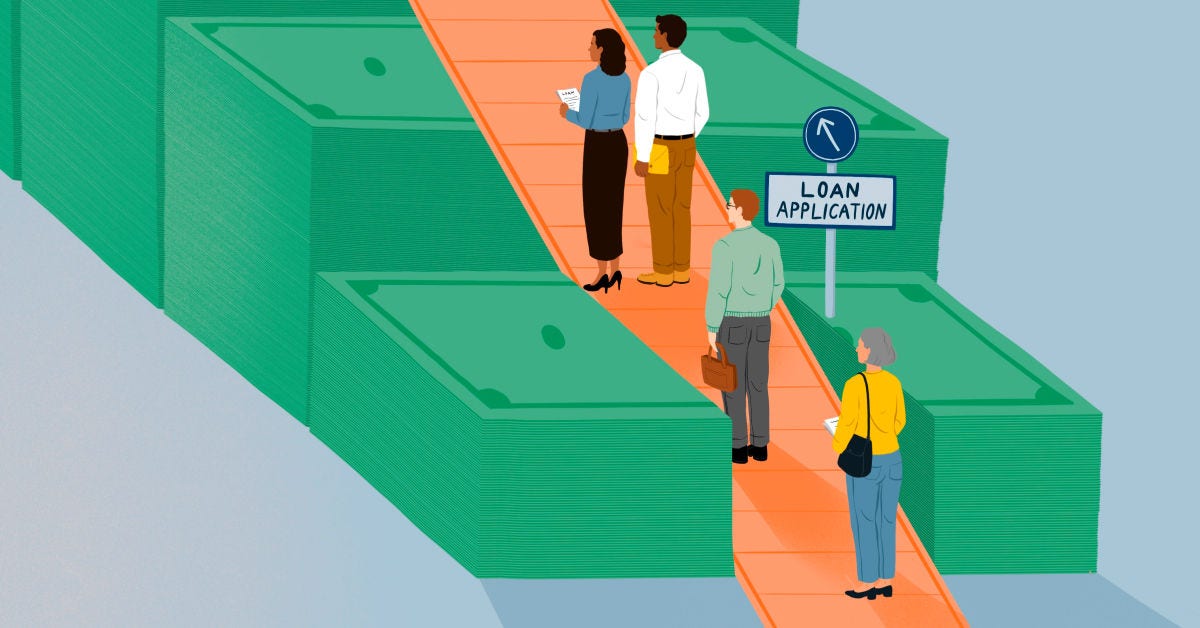
For high-earning professionals managing complex financial profiles, applying for a personal loan can be a strategic move. Whether you're consolidating high-interest debt, funding a home improvement, or covering a major expense, the process follows a predictable sequence:
- Check your credit
- Compare lenders through personal loan prequalification
- Gather the documents needed for a personal loan
- Submit your application
But it’s what you do prior to getting the personal loan—comparing lenders, APRs, and fees—that makes the biggest difference in your total cost.
This guide walks you through each step, including what lenders look for, which documents to prepare, and how to compare loan offers to find the best fit for your financial profile.
How to apply for a personal loan
The process from first inquiry to funded loan typically takes less than a week. Here's exactly what to expect at each stage.
1. Check your credit and DTI
Pull your credit report to check it for errors and dispute inaccuracies that may be affecting your score before you apply. AnnualCreditReport.com and most major card companies provide free copies of your report.
Then, calculate your debt-to-income ratio (DTI), which is your total monthly debt payments divided by your gross monthly income.
Many lenders prefer a DTI below 36% for an unsecured loan, but some, including BHG Financial, will consider higher ratios. High earners may qualify with elevated DTIs because strong, verifiable income tells lenders you can comfortably handle the payments.
Providers such as Credit Karma, Credible, and Experian provide ongoing credit monitoring services as well as recommended loan providers with whom you are more likely to be approved based on your profile.
2. Estimate amount and determine purpose and term
Borrow only what you need and think carefully about term length before you decide on a lender. Longer terms reduce your monthly payment but increase the total interest you pay over the life of the loan.
For example, here's how a $50,000 loan at 10% APR compares across two term lengths:
|
|
5-year term |
10-year term |
|---|---|---|
|
Monthly payment |
$1,062 |
$661 |
|
Total interest |
$13,741 |
$29,290 |
|
Total cost |
$63,741 |
$79,290 |
Image is a representative example for illustrative purposes only and does not reflect actual customer information.
A 10-year term cuts your monthly payment nearly in half, but you'll pay more than twice the interest over the life of the loan.
Knowing your priority (lower monthly payments vs. lower total cost) before you start comparing lenders makes it much easier to evaluate offers from the preferred viewpoint.
3. Prequalify with multiple lenders
Personal loan prequalification uses a soft credit inquiry, which means it has no impact on your credit score. Compare offers from three to five lenders, including estimated APRs, terms, fees, and funding timelines.
Seeing those offers side by side gives you real data to work with before committing to a formal application.
See your offer † real fast
Just a few easy steps to get prequalified!
† This is not a guaranteed offer of credit and is subject to credit approval.
4. Compare total cost and choose a lender
As you compare offers, focus on APR, not just the interest rate. APR reflects the interest rate plus any additional fees charged by the lender, so it gives you a clearer picture of the true cost of the loan.
Beyond APR, compare:
- Origination fees
- Term length compared to monthly payment amount
- Payment date flexibility
- Autopay discounts
- Late fee policies
- Ability to pay off the loan early, and whether there are repayment penalties for doing so
- Funding speed
- Flexibility in how you use the funds to match your desired purpose
Considering these factors will ensure the loan—and the lender—fit your budget, cash flow needs, and long-term financial goals.
5. Submit your application
Most lenders verify the same four things during the application process: identity, income, employment, and address, though the specific items vary.
Personal loan approval and funding can move quickly, especially if you upload your documents and promptly respond to any verification requests. Formally applying for a loan triggers a hard credit inquiry at funding, which may temporarily lower your score by a few points, but this is normal and expected.
6. Accept funds and begin repayment
Before you sign, review the final loan agreement carefully to confirm that the rate, term, monthly payment, and fees match what you were quoted. Once everything checks out, sign electronically and funds are typically disbursed within a few days.
If you're getting a debt consolidation loan, confirm whether your lender pays creditors directly or deposits funds for you to manage. Setting up autopay often qualifies you for a rate discount and ensures you never miss a payment.
Documents required to apply for a personal loan
Getting your paperwork together before you apply is one of the simplest ways to speed up approval and funding. The specifics vary depending on how you earn your income, but most lenders are looking for the same core information.
Here's exactly what to prepare based on your employment situation:
W-2 employees
- Government-issued photo ID (driver's license or passport)
- Social Security number
- Two recent pay stubs and/or most recent W-2
- Employer name and contact information
- Proof of address (utility bill, lease agreement, or mortgage or bank statement)
- Bank account routing and account numbers for ACH disbursement
Self-employed/1099
Variable income requires more documentation because lenders need to establish a consistent earnings pattern.
- Government-issued photo ID
- Social Security number
- Last two years of federal tax returns, including Schedule C (or K-1 if you have partnership or business income)
- Three to six months of personal bank statements
- Year-to-date profit and loss statement (if requested)
- Proof of address
Business owners
Everything in the self-employed list, plus:
- Business tax returns (typically two years)
- Business bank statements (three to six months)
- Ownership documentation (articles of incorporation, operating agreement, or similar)
- Documentation of additional income streams, if applicable
Joint/co-borrower or cosigner
If you're adding a co-borrower, they'll need to provide their own identity and income documentation based on their employment situation, so refer to whichever list above applies to them.
A co-borrower can strengthen your application if one of you has an elevated DTI or a thinner credit profile. Not all lenders accommodate co-borrowers, but BHG Financial lets you add one during the application process.
Prequalification vs. preapproval vs. application
These three terms are often used interchangeably, but they represent different stages and impact your credit differently.
Prequalification is a soft inquiry, so it doesn’t affect your credit and carries no commitment. Think of it as a rate estimate, not a guarantee. You provide basic information, and the lender returns estimated rates and terms.
Preapproval is a step further, and is essentially a conditional loan offer, provided there is no material change in your credit profile, and the customer applies within a certain time period. The definition varies by lender. Some use it to describe a more thorough soft-pull review; others treat it the same as a formal application.
With a formal application, the lender verifies your identity, income, employment, and credit history in full, which triggers a hard inquiry. This may temporarily lower your score by a few points and remain on your credit report for up to two years—but it's also the step that leads to an approval.
One thing to keep in mind: With mortgages and auto loans, multiple hard inquiries within a short window are often counted as one, which protects your credit score while you shop around.
Personal loans don't always work the same way. That's why it's smart to do your comparison shopping through prequalification and save the formal application for your chosen lender.
How to compare cost and terms
Choosing the lowest advertised rate isn't always the same as choosing the lowest-cost loan. Here's what to evaluate before you sign.
- APR vs. interest rate: APR is the most accurate number for comparing offers. A loan with a lower rate, but a high origination fee may cost more than a loan with a slightly higher rate and no fee.
- Origination fee and net proceeds: Some lenders may charge an origination fee, which will be deducted from your loan before disbursement. For example, if you borrow $25,000 with a 3% origination fee, you’d receive $24,250 but repay the full $25,000. Factor this into how much you actually need to request.
- Term length and total interest: Longer terms lower your monthly payment but increase total interest paid. Run the numbers for both scenarios before deciding.
- Payment flexibility: Some lenders let you choose your payment due date or offer a short grace period. This is worth checking if your income arrives on a specific schedule.
- Prepayment penalty: Most personal loan institutions, including BHG Financial, do not charge a penalty for paying off your loan early. Confirm this before signing.
- Funding speed: If timing matters, ask specifically how many business days pass between signing and when funds hit your account.
Get a large, long-term personal loan through BHG Financial
BHG Financial specializes in large personal loans up to $250,0001 designed for high earners. With fixed rates and terms from two to 10 years1,2, it’s a strong option for borrowers who need more than a standard loan—or lender—can provide.
Every application is supported by a dedicated, U.S.-based loan specialist who guides you through the process from start to finish. There’s never any unnecessary back-and-forth, application fees, or prepayment penalties.
If you move forward, you can receive an approval decision in as little as 24 hours3 and funding in as few as five days,3 with minimal paperwork required.
Ready to see what’s possible for your personal loan? Checking your rate takes only a few seconds and won't affect your credit score.4 Explore personalized loan options today.3
Check my rate
See your offer † real fast
Just a few easy steps to get prequalified!
† This is not a guaranteed offer of credit and is subject to credit approval.
Frequently asked questions (FAQs)
How do you apply for a personal loan online?
Applying online follows the same steps as applying in person: prequalify, compare offers, gather documents, and submit a formal application. The main differences are speed and flexibility.
Online lenders typically offer faster decisions, often within 24 hours, and allow you to upload documents, verify your identity, and sign your agreement electronically.
How can you be eligible for a personal loan?
Eligibility depends on a combination of credit score, income stability, and DTI. BHG Financial requires a minimum credit score of 640 for personal loans.
Many lenders prefer a DTI below 36%, but that isn't a hard cutoff—BHG Financial will consider higher ratios when your income is strong enough to back it up.
Income requirements vary, but lenders want to see consistent, verifiable earnings regardless of how you're employed.
What documents do you need to apply for a personal loan?
Most lenders require a government-issued photo ID, your Social Security number, proof of income (pay stubs, W-2s, or tax returns, depending on your employment type), proof of address, and your bank account information for disbursement.
Self-employed borrowers should also prepare two years of tax returns, 1099 forms, and three to six months of bank statements.
Not all solutions, loan amounts, rates or terms are available in all states.
1 Terms subject to credit approval upon completion of an application. Loan sizes, interest rates, and loan terms vary based on the applicant's credit profile. Not all applicants will qualify for the lowest rate.
2 Personal Loan Repayment Example: A $60,000 personal loan with a 7-year term and an APR of 17.06% would require 84 monthly payments of $1,191.38.
3 This is not a guaranteed offer of credit and is subject to credit approval.
4 There is no impact on your credit for applying. For personal loans, a complete credit history, which will appear as an inquiry on your credit report, will be performed upon acceptance and funding of the loan and may impact your credit.
Consumer loans funded by Pinnacle Bank, a Tennessee bank, or County Bank. Equal Housing Lenders. 
No application fees, commitment, or impact on personal credit to estimate your payment.
For California Residents: Personal loans made or arranged pursuant to a California Financing Law license - Number 603G493.

Bankers Healthcare Group, LLC d/b/a BHG Financial NMLS ID# 2040829