
Personal loans
Customized financing to consolidate high-interest debt and unlock financial flexibility.
About BHG
Programs
$130,000 Personal Loan: How to Get a $130K Loan
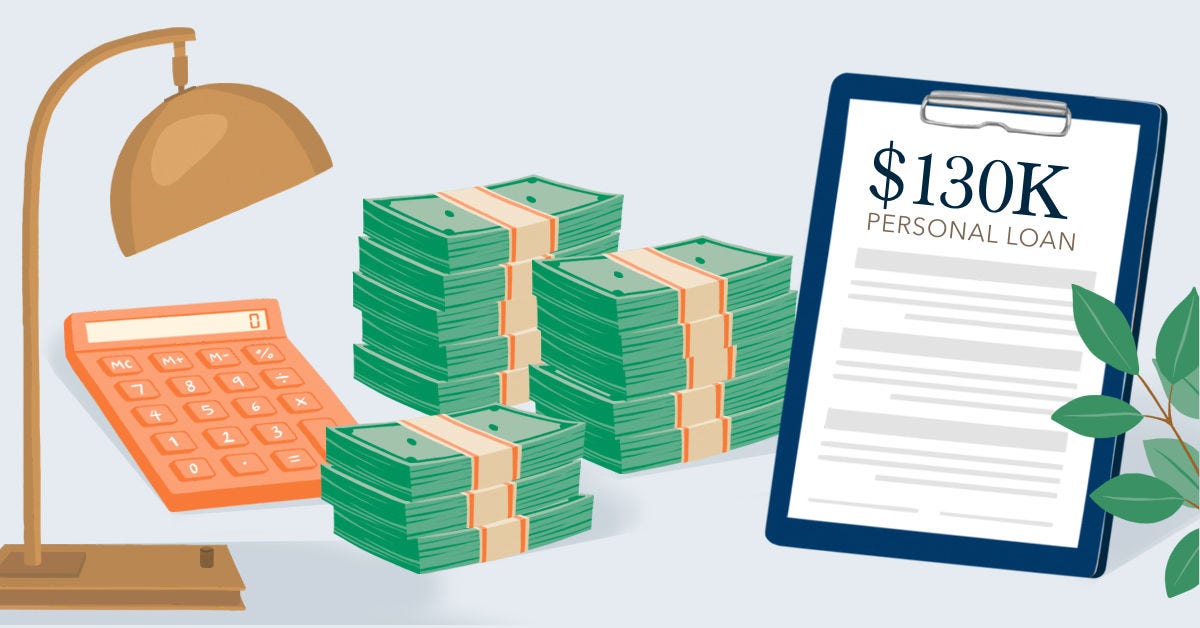
A $130,000 personal loan is possible, but it's not something most lenders can deliver. The majority of banks and credit unions cap unsecured personal loans at $50,000 to $100,000, which leaves you with limited options if you need more funds to consolidate debt, smooth out your cash flow, or make a large purchase.
But if you choose the right lender and have the right financial profile, you can still qualify for a large personal loan. This guide will walk you through estimating potential payments and interest costs, preparing your finances, and applying for a $130,000 personal loan, as well as which alternatives you can consider.
Key takeaways
Since a $130,000 personal loan is larger than what most traditional banks and credit unions offer, look for options from specialty and high-limit lenders. Expect to need good to excellent credit, an acceptable debt-to-income (DTI) ratio, and stable, verifiable income to qualify. Research multiple lenders and loan products, compare prequalification offers, and consider your whole financial picture to find the right fit.
Can you get a $130,000 personal loan?
Yes, you can get a $130,000 personal loan, but your options are more limited than they would be for a $20,000 or $50,000 personal loan. Most mainstream lenders cap unsecured personal loans well below $130,000. That gap is real, and it pushes many borrowers toward home equity products by default, rather than by choice.
For qualified applicants, a $130,000 unsecured personal loan is available through specialty or high-limit lenders. BHG Financial, for example, offers personal loans from $20,000 to $250,0001 with no collateral needed.
To qualify for a loan of this size, you’ll typically need to meet strict requirements, including having a good to excellent credit score, stable and verifiable income, and a manageable debt-to-income ratio.
See your offer † real fast
Just a few easy steps to get prequalified!
† This is not a guaranteed offer of credit and is subject to credit approval.
What are the monthly payments on a $130,000 loan?
Your monthly payment on a $130,000 personal loan depends on two variables: your annual percentage rate, or APR, and your loan term.
As of November 2025, the national average personal loan APR was 11.65%, according to the Federal Reserve. Personal loan terms tend to range from 2 to 10 years, depending on the lender.
Here’s what your monthly payment and total interest for a $130,000 loan could look like based on different terms and APRs:
|
Term |
APR |
Monthly payment |
Total interest |
|---|---|---|---|
|
5 years |
9% |
$2,699 |
$31,915 |
|
5 years |
12% |
$2,892 |
$43,507 |
|
7 years |
9% |
$2,092 |
$43,693 |
|
7 years |
12% |
$2,295 |
$62,768 |
|
10 years |
9% |
$1,647 |
$67,614 |
|
10 years |
12% |
$1,895 |
$93,815 |
Image is a representative example for illustrative purposes only and does not reflect actual customer information.
These examples show that a longer term lowers your monthly payment but increases the total interest you pay over the life of the loan. On the other hand, a shorter term costs more each month but reduces your total costs. That’s why it’s important to choose a term that balances affordability with interest savings.
How to qualify for a $130,000 personal loan
Six-figure unsecured loans require a stronger financial profile than smaller personal loans. Lenders are extending significant credit without collateral, so they look closely at your credit history, income stability, and overall debt load. Here's what matters most when getting a personal loan of this amount.
Credit history
Good to excellent credit is typically required for a $130,000 personal loan. According to myFICO, a credit score of 670 or higher is considered “good,” but lender rules vary. If you apply through BHG Financial, you’ll need a minimum score of 640.
Lenders also look beyond your credit score and review the depth and cleanliness of your credit report. This includes your payment history, average account age, credit utilization, and any derogatory marks, such as foreclosures or bankruptcies.
A thin credit file with few accounts or a short history can work against you even if your score looks solid. But if you have a long, clean credit history with a mix of account types, that strengthens your application for a loan of this size.
Income
Lenders want to see that your income is stable and documentable. While W-2 income is the most straightforward, 1099 income, K-1 distributions, and business income are all considered when lenders can verify them.
For high-income professionals with complex income structures, working with a lender that understands your financial profile—rather than one that only accepts standard W-2 documentation—makes a real difference.
DTI ratio and cash flow
Even if you have a high, stable income, lenders will want to check that you can comfortably cover your new personal loan payment alongside existing obligations. They’ll also look at your residual cash flow for a loan of this size.
Your debt-to-income ratio (DTI) is the percentage of your gross monthly income that goes toward debt payments. Many lenders prefer a DTI ratio below 36% to 43%. However, compensating factors—such as strong liquidity, significant assets, or a high income—can offset a higher ratio for well-qualified borrowers.
If you have a high DTI ratio, consider paying off high-interest debt, consolidating credit card debt, or increasing your monthly income to qualify for the best personal loan offers.
Documentation requirements
Having your documents ready will speed up the process considerably. For a $130,000 personal loan, expect to provide the following:
- Government-issued photo ID, such as a driver’s license or passport
- Recent pay stubs and W-2s, or 1099s and K-1s for self-employed or multi-income borrowers
- Federal tax returns for the past one to two years
- Recent bank statements
- Employer information or business documentation, if applicable
How to apply for a $130,000 personal loan?
After you’ve reviewed and prepared your finances, you can take these three simple steps to apply for a $130,000 personal loan:
- Prequalify: Most providers, including BHG Financial, offer prequalification, which lets you see potential loan amounts, interest rates, and term options with only a soft credit check. After providing basic information, you’ll be able to compare offers across multiple lenders to find the best option. Keep your monthly cash flow, potential costs, and financial goals in mind during this process.
- Formally apply: Once you’ve chosen the right lender and personal loan, you can submit an official application. This requires providing extensive personal and financial details and submitting documentation to verify your identity, income, and residence. Stay in close contact with your lender and answer any questions promptly to keep the process moving.
- Get your funds: After your lender approves you, expect to sign your final loan documents and then receive your personal loan funds in around one to two weeks. Depending on the loan’s purpose and arrangement, the lender might deposit these funds into your bank account or pay existing lenders directly (for debt consolidation loans).
$130,000 personal loan vs. HELOC vs. cash-out refinance
When you need $130,000, two alternative financing paths come up most often: a home equity line of credit (HELOC) or a cash-out refinance. Since each has real trade-offs, the right choice depends on your timeline, risk tolerance, and comfort with putting your home on the line.
Here’s a quick look at how these home equity products compare to personal loans.
|
Feature |
Unsecured personal loan |
HELOC |
Cash-out refinance |
|---|---|---|---|
|
Rate type |
Typically fixed |
Typically variable |
Fixed or adjustable |
|
Collateral |
Unsecured; no home needed |
Secured by home |
Secured by home |
|
Cost to close |
Possible origination fee of 1% to 10% of the loan amount |
Possible annual fees and closing costs of 2%–5% of the credit line |
Closing costs typically 2%–6% of the loan amount |
|
Funding speed |
As few as 5 days; no appraisal |
2–6 weeks (appraisal required) |
30–60 days; full closing process |
|
Payment certainty |
Fixed, predictable payments |
Variable payments based on draw/payment phase and interest rate |
Predictable if fixed rate |
Sources: Investopedia; The Mortgage Reports
When an unsecured personal loan may be right
A $130,000 personal loan wins based on speed, simplicity, and payment certainty. There's no appraisal, long closing timeline, or lien placed on your home. You can get your funds quickly with less hassle, but you don’t risk losing your home if you default. Plus, fixed rates and payments make budgeting and planning your loan payoff simpler.
If the current interest rate environment is favorable or you don't have significant equity, an unsecured loan may also be more cost-effective once you factor in closing costs and other fees associated with a HELOC or cash-out refinance.
When home equity products can make sense
If you have at least 15% to 20% equity in your home, a HELOC or cash-out refinance can be appealing for borrowing six-figure amounts. Both products can carry lower rates than unsecured personal loans in some scenarios, and their longer repayment timelines (often 10 to 30 years) can lead to more manageable monthly payments. Plus, the IRS offers potential tax breaks depending on how you use the funds.
However, they also involve real trade-offs. Your home secures the debt, so you risk facing foreclosure if you can’t keep up with your payments. Additionally, variable rates on HELOCs can unpredictably increase your payments and complicate budgeting, while the closing process for both HELOCs and cash-out refinances can take weeks.
In cases where you’re fine with the drawbacks, don’t expect to default on payments, and want to maximize interest savings, home equity products may be a suitable alternative. But if you need funds quickly or prefer not to tie financing to your home, an unsecured personal loan compared to a HELOC or cash-out refinance is often the cleaner path.
See your offer † real fast
Just a few easy steps to get prequalified!
† This is not a guaranteed offer of credit and is subject to credit approval.
Get a $130,0001 loan through BHG Financial
With personal loans up to $250,000,1 flexible terms of 2 to 10 years,1,2 and fixed rates, BHG Financial offers high-income borrowers an alternative to home equity financing—without an appraisal, closing costs, or collateral. As a well-qualified borrower, you can borrow large amounts for debt consolidation loans, home improvement projects, and other uses.
Our personalized solutions offer affordable monthly payments that align with your cash flow and a streamlined application process with minimal documentation and no application fees. You can also expect dedicated U.S.-based concierge support, prequalification with no impact on your credit,3 and funding in as little as 5 days.4
If you’re ready to learn more, get a personalized loan offer within seconds4 to see your potential payment amount and terms with no commitment.
Check my rate
See your offer † real fast
Just a few easy steps to get prequalified!
† This is not a guaranteed offer of credit and is subject to credit approval.
$110,000 personal loan FAQ
Can you get a $130,000 personal loan from most lenders?
In most cases, you can’t get a $130,000 personal loan from traditional banks or credit unions, as they often limit loans to $50,000 to $100,000. BHG Financial is one of the few personal loan providers that offer an unsecured $130,0001 personal loan.
What credit score do you need for a $130,000 personal loan?
There isn’t a single required credit score for a $130,000 personal loan, because lenders underwrite using multiple factors, such as your credit score, income, employment stability, existing debt, and cash flow. That said, because $130,000 is a large unsecured balance, lenders that even consider it typically expect strong credit and a low debt-to-income ratio.
Recommended articles
Debt Consolidation
7 Key Factors That Determine Eligibility for High‑Limit Debt Consolidation Loans
January 12, 2026 | 7 min read

Personal Loans
How to Get a $100,000 Loan: Requirements, Rates, and Alternatives
May 23, 2025 | 8 min read

Personal Loans
Are Personal Loans a Good Idea for High Earners? What the Data Says
October 31, 2025 | 7 min read
Personal Loans
Should You Dip Into Savings or Use a Loan? How to Decide
October 14, 2025 | 6 min read
Debt Consolidation
When to Pay Credit Card Bill to Increase Credit Score
August 28, 2025 | 7 min read
Personal Loans
Personal Loan vs Credit Card: The Surprising Way to Cut Interest Costs
June 23, 2025 | 6 min read
Advertised rates are subject to change without notice.
Not all solutions, loan amounts, rates or terms are available in all states.
1 Terms subject to credit approval upon completion of an application. Loan sizes, interest rates, and loan terms vary based on the applicant's credit profile. Not all applicants will qualify for the lowest rate.
2 Personal Loan Repayment Example: A $60,000 personal loan with a 7-year term and an APR of 17.06% would require 84 monthly payments of $1,191.38.
3 There is no impact on your credit for applying. For personal loans, a complete credit history, which will appear as an inquiry on your credit report, will be performed upon acceptance and funding of the loan and may impact your credit.
4 This is not a guaranteed offer of credit and is subject to credit approval.
No application fees, commitment, or impact on personal credit to estimate your payment.
Consumer loans funded by Pinnacle Bank, a Tennessee bank, or County Bank. Equal Housing Lenders. 
For California Residents: Personal loans made or arranged pursuant to a California Financing Law license - Number 603G493.

Bankers Healthcare Group, LLC d/b/a BHG Financial NMLS ID# 2040829