
Personal loans
Customized financing to consolidate high-interest debt and unlock financial flexibility.
About BHG
Programs
How To Get a $50,000 Loan: Requirements and Options
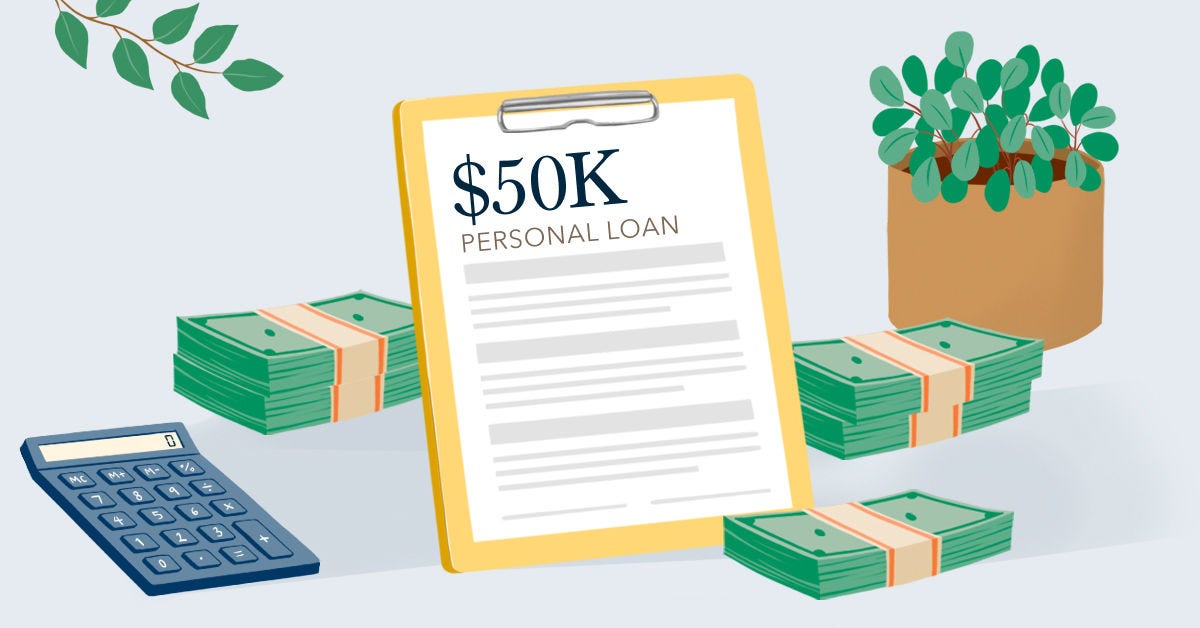
A $50,000 loan can cover a lot of expenses, including paying down high-interest credit card debt, funding a home renovation, or smoothing out a cash flow gap when your income fluctuates. But getting approved for a $50,000 loan at a rate that makes sense for you requires knowing what lenders look for and where to find the right fit.
We’ll explore what qualifies you for a $50,000 personal loan, what your monthly payment could look like across different terms and rates, how long the process takes, and when a personal loan is and isn’t the right call.
KEY TAKEAWAYS
You can get a $50,000 personal loan from many banks, credit unions, and online lenders. Your monthly payment will depend on your loan term and APR, so compare offers and carefully consider your budget. Expect to have a good credit score, manageable debt-to-income ratio, and stable, verifiable income to get approved.
What is a $50,000 personal loan?
A $50,000 personal loan is an unsecured installment loan, meaning no collateral is required. It typically features a fixed interest rate, predictable monthly payment, and set repayment term. You receive the full $50,000 as a lump sum and repay it in equal monthly installments over the life of the loan.
Common uses include consolidating high-interest credit card debt, financing home improvements, covering large medical or legal expenses, or managing a significant personal purchase. While terms typically range from 24 to 84 months with most lenders, BHG Financial offers longer terms from 24 to 120 months.1,2
A $50,000 personal loan is different from a home equity line of credit (HELOC), home equity loan, or a cash-out refinance, all of which use your home as collateral. It’s also distinct from a small business loan, which is underwritten based on your company’s financials and intended for commercial use (such as purchasing new equipment or adding a location).
More choices. More flexibility.
Explore personal loan options with extended terms†
† This is not a guaranteed offer of credit and is subject to credit approval.
What are the payments on a $50,000 loan?
Your monthly payment on a $50,000 loan depends on the annual percentage rate, or APR, and the term length. Note that APRs vary based on factors like your lender, loan term, personal financial factors, and market conditions. For context, the Federal Reserve reported an average personal loan APR of almost 12% in February 2026.
The table below shows an example comparison of estimated monthly payments and total interest paid for a $50,000 balance over a seven-year term, funded by a high-interest credit card or a personal loan.
Estimated monthly payments on a $50,000 loan
|
|
High-interest credit card |
Personal loan |
|---|---|---|
|
Representative APR |
22.3% |
11.96% |
|
Monthly payment |
$1,181 |
$882 |
|
Potential interest paid |
$49,168 |
$25,133 |
Image is a representative example for illustrative purposes only and does not reflect actual customer information.
FYI: Longer terms lower your monthly payment but increase the total interest you pay over the life of the loan. A 10-year term at 10% APR, for example, costs roughly $15,580 more in total interest than a 5-year term at the same rate. That tradeoff is worth understanding, along with your cash flow situation, before you choose a term.
How to qualify for a $50,000 loan
Lenders evaluate several factors when reviewing a $50,000 loan application. Here's what most prime lenders look for.
Credit score
Most lenders require a minimum credit score of 670 to approve a $50,000 personal loan, though approval at that threshold often comes with higher APRs. Borrowers with scores of 720 or above typically access better pricing and broader term options.
A stronger credit score signals lower risk to lenders, which generally translates to a lower APR and more favorable terms. If your score is near the lower end of the qualifying range, adding a co-borrower with stronger credit can improve your approval odds and rate.
FYI: You’ll need a minimum credit score of 640 to get a personal loan through BHG Financial, but we look beyond credit metrics when determining your approval.
Income and documentation
Lenders want to see a stable, verifiable income that supports your requested loan amount and monthly payment. For most applicants, that means providing recent pay stubs, W-2s, and sometimes two years of tax returns. If you have multiple income streams — such as a salary, rental income, or business distributions — lenders may ask for K-1s or additional documentation to assess the full picture.
Depending on the lender, you may need to meet a minimum income requirement to qualify for a $50,000 personal loan, and a lower income could result in a smaller approval amount. A super-prime borrower typically has an income exceeding $150,000 and excellent credit.
Ultimately, your lender will consider your monthly income compared to your monthly obligations to ensure you can reliably make your new monthly payment. They’ll also look at the stability of all income sources, such as your employment income or business revenue.
Debt-to-income (DTI) ratio
Your debt-to-income ratio compares your total monthly debts to your gross monthly income. Most prime lenders prefer a DTI ratio of 43% or lower, with 36% or lower considered strong. For someone making $180,000 per year ($15,000 per month), monthly obligations shouldn’t exceed $5,400 to $6,450 to meet these limits.
High earners with multiple income streams sometimes carry higher nominal debt loads that look concerning on paper but are well within their capacity to manage. Some premium lenders, including BHG Financial, work with qualified borrowers in this situation.
How to get a $50,000 loan
The process for getting a personal loan is straightforward, with minimal paperwork and no application fee to check your rate.
- Find options: You can find $50,000 personal loans at many traditional banks, credit unions, and online lenders. Research several providers online, review their product offerings, and read what other customers say about their borrowing experience. Narrow down a few potential options before moving forward.
- Complete prequalification: Prequalify for a personal loan by submitting basic information to each lender to see estimated rates and payment options. This process doesn’t affect your credit score since it uses a soft credit pull.
- Pick the right lender: Compare your prequalification offers to choose the lender with the best terms and excellent service. Key factors to consider include the lender’s reputation, funding speed, ease of application, APR and other fees, and loan flexibility.
- Submit an application: Once you decide to move forward, submit an application along with all the required documentation. You'll typically need to provide thorough information and verify your identity, income, and address. Expect a fast application decision, often within one to three days.
- Receive your funds: After loan approval, you’ll typically receive your funds within one week. Many lenders deposit the money into your bank account, but if the loan is for debt consolidation, they might instead pay your existing creditors directly.
Take charge of your financial future
View prequalified loan offers and plan your next move
Alternatives to a $50,000 loan
A $50,000 personal loan isn't always the right tool. Here's how it compares to three other common options.
|
|
Personal loan |
HELOC |
0% balance transfer card |
Cash-out refinance |
|---|---|---|---|---|
|
Collateral required |
No |
Yes (home) |
No |
Yes (home) |
|
Rate type |
Typically fixed |
Typically variable |
Promotional (then variable) |
Fixed or variable |
|
Typical term |
3–10 years |
5–10 years for draw period plus 10–20 years for repayment |
12–21 months promo |
15–30 years |
|
Funding speed |
A few days |
2–6 weeks |
Days (card arrival) |
30–60 days |
|
Best for |
Debt consolidation, large expenses, cash flow needs |
Home improvements using equity |
Short-term balance payoff |
Large equity extraction |
|
Credit impact |
Soft pull to prequalify and hard pull to officially apply |
Hard pull required |
Hard pull required |
Hard pull required |
HELOC
According to the Nebraska Department of Banking and Finance, a HELOC compared to a personal loan may offer a lower rate. It can also offer greater flexibility, as you can draw only what you need from the credit line and make interest-only payments initially.
However, it puts your home at risk if you can't repay the amount. It also carries a variable rate, which means your payment amount and interest costs can increase over time. Plus, the process typically requires paying closing costs of 2% to 5% of the credit line and takes several weeks, which isn’t ideal for funding urgent expenses.
0% balance transfer card
A 0% balance transfer card can be cost-effective for smaller balances you can pay off within the promotional window, which typically runs 12 to 21 months. It’s a popular choice for reducing high-interest debt and offers a simple, fast application process.
But the credit limit may not reach $50,000, and a balance transfer fee of 3% to 5% of the transferred amount typically applies. Once the promotional period ends, the rate resets to a standard variable APR, which may exceed personal loan rates for prime borrowers.
Cash-out refinance
A cash-out refinance involves replacing your existing mortgage with a new, larger one, allowing you to use the excess funds for various purposes. It's a way to take advantage of current mortgage rates, which are often more competitive than personal loan rates, potentially change the loan term, and borrow against equity all at once.
This personal loan alternative involves going through an extensive mortgage application process that can take up to a few months and requires paying closing costs of 2% to 5% of the loan amount. And like with a HELOC, you must put your home at risk as collateral.
While a cash-out refinance may make sense if you're already refinancing for other reasons, it's rarely the fastest or simplest path to $50,000.
Get a $50,0001 personal loan through BHG Financial
BHG Financial offers personal loans up to $250,0001 with terms up to 101,2 years, which are among the longest available from any personal lender. That combination of loan size and term flexibility is designed for borrowers who need meaningful capital with payments that fit their actual budget.
Whether you’re seeking a debt consolidation loan or covering a major expense, our personalized solutions require no collateral, offer fixed rates and payments, and have no application fee or prepayment penalties. We also have U.S.-based loan specialists who understand complex income profiles and evaluate your whole financial picture.
Get a quick payment estimate today with no impact3 on your credit score. You could be approved within as little as 24 hours4 and you could receive your $50,0001 within five days.4
Check my rate
See your offer † real fast
Just a few easy steps to get prequalified!
† This is not a guaranteed offer of credit and is subject to credit approval.
$50,000 personal loan FAQ
How hard is it to get a $50,000 loan?
Getting a $50,000 loan is usually harder than smaller loans because lenders scrutinize your ability to repay a larger balance. Approval typically depends on a good credit score, stable income, a manageable DTI ratio, and a strong credit history. While many lenders offer unsecured $50,000 personal loans, stronger applicants generally qualify more easily and get lower APRs.
Can you get a $50,000 loan instantly?
You generally can’t get a $50,000 loan instantly, as underwriting, identity checks, and funding take time. Some lenders offer same-day or next-business-day funding after approval, but you still must complete an application, provide documentation, and complete verification steps. To move faster, apply with correct information, choose a lender that supports quick funding, and have your documents ready (government-issued ID, proof of income, and banking details).
Recommended articles
Debt Consolidation
7 Key Factors That Determine Eligibility for High‑Limit Debt Consolidation Loans
January 12, 2026 | 7 min read

Personal Loans
How to Get a $100,000 Loan: Requirements, Rates, and Alternatives
May 23, 2025 | 8 min read
Personal Loans
Are Personal Loans a Good Idea for High Earners? What the Data Says
October 31, 2025 | 7 min read

Personal Loans
Should You Dip Into Savings or Use a Loan? How to Decide
October 14, 2025 | 6 min read
Debt Consolidation
When to Pay Credit Card Bill to Increase Credit Score
August 28, 2025 | 7 min read
Personal Loans
Personal Loan vs Credit Card: The Surprising Way to Cut Interest Costs
June 23, 2025 | 6 min read
Not all solutions, loan amounts, rates or terms are available in all states.
1 Terms subject to credit approval upon completion of an application. Loan sizes, interest rates, and loan terms vary based on the applicant's credit profile. Not all applicants will qualify for the lowest rate.
2 Personal Loan Repayment Example: A $60,000 personal loan with a 7-year term and an APR of 17.06% would require 84 monthly payments of $1,191.38.
3 There is no impact on your credit for applying. For personal loans, a complete credit history, which will appear as an inquiry on your credit report, will be performed upon acceptance and funding of the loan and may impact your credit.
4 This is not a guaranteed offer of credit and is subject to credit approval.
No application fees, commitment, or impact on personal credit to estimate your payment.
Consumer loans funded by Pinnacle Bank, a Tennessee bank, or County Bank. Equal Housing Lenders. 
For California Residents: Personal loans made or arranged pursuant to a California Financing Law license - Number 603G493.

Bankers Healthcare Group, LLC d/b/a BHG Financial NMLS ID# 2040829