
Personal loans
Customized financing to consolidate high-interest debt and unlock financial flexibility.
About BHG
Programs
$160,000 Personal Loan: Where and How to Get a Large Loan
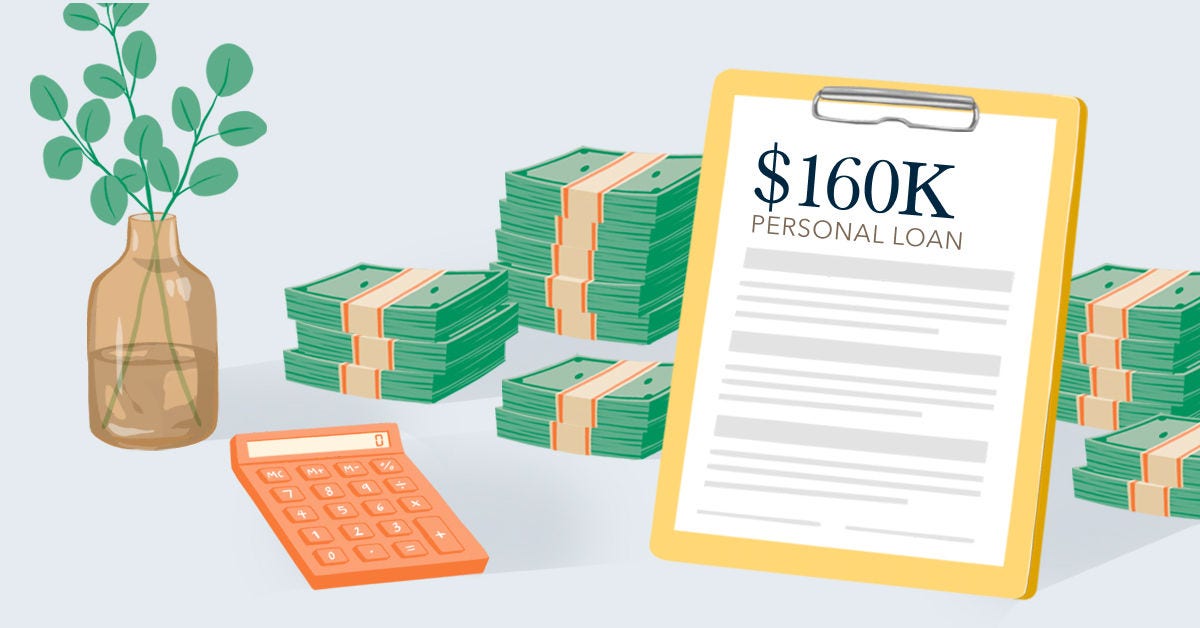
If you’re considering a $160,000 loan, you’re likely evaluating two key factors: how the monthly payment fits within your budget, and whether a personal loan of this size is realistic without requiring collateral, such as your home.
While personal loans of $100,000 and more are less common than smaller loans, they can be available for well-qualified borrowers—especially high earners with strong credit and manageable existing debt. With the right lender and qualifications, you can borrow substantial funds to consolidate debt, address cash flow needs, or make purchases.
We'll explain what lenders look for, how much payment might be, which alternatives you can consider, and how to check personal loan options through BHG Financial.
Key takeaways
While $160,000 personal loans are harder to find, approval is possible if you’re a well-qualified borrower and work with a lender specializing in high-limit personal loans (like BHG Financial). You’ll need a good to excellent credit score, reliable and verifiable income, and manageable existing debt.
To find the right loan, compare monthly payments and APRs, and consider alternatives like HELOCs if you don’t qualify.
Can you get a $160,000 personal loan?
Yes, you can get a $160,000 personal loan. However, it’s above the maximum set by many mainstream lenders, such as traditional banks and credit unions, which often cap unsecured personal loans at $50,000 to $100,000.
That means your options may narrow to lenders that specialize in larger loan amounts, or you may need to consider alternatives like a secured loan. You’ll also likely need to have a robust financial profile to borrow this large amount.
FYI: BHG Financial offers large unsecured personal loans of up to $250,0001, with flexible terms and predictable monthly payments.
See your offer † real fast
Just a few easy steps to get prequalified!
† This is not a guaranteed offer of credit and is subject to credit approval.
Who usually qualifies for a $160,000 personal loan?
While lender requirements vary, you’ll typically need to have the following to qualify for a $160,000 unsecured loan:
- Good to excellent credit: A strong credit score reassures lenders that you’re likely to repay a large personal loan. Although myFICO classifies 670 and above as “good,” BHG Financial accepts scores starting at 640 and takes a broader view of your finances. But know that a lower credit score can mean less favorable terms, such as a higher annual percentage rate (APR).
- Stable, verifiable income: Lenders not only want to see that you earn a high-enough income to manage payments on a six-figure loan comfortably, but they also want that income to be stable and verifiable through documentation. Note that multiple income sources can qualify, including employment, business, investment, and rental income.
- Manageable debt-to-income (DTI) ratio: Getting a $160,000 personal loan is often more challenging if your total debt load (including the new monthly payment) is high compared to your income. Lenders typically prefer borrowers with DTI ratios below 36%. However, you may still qualify with an elevated ratio if you have great credit and a high income.
If you fall short of these requirements and don’t need your funds urgently, it can be worth taking some time to improve your credit score, reduce your debt, or increase your verifiable income. Otherwise, consider providers that look at your whole financial picture rather than focusing on a single area, like BHG Financial.
What are the payments on a $160,000 loan?
The monthly payment on a $160,000 loan will depend on the chosen term length and the interest rate offered based on your creditworthiness. Personal loan terms tend to range from three to 10 years, while Federal Reserve data shows that personal loan APRs average around 12%.
The table below shows estimated payments and total interest for a $160,000 personal loan across common terms and APRs. Remember that these figures are illustrative estimates; your actual offer will depend on your credit profile, income, existing debts, and other underwriting factors.
|
Term |
APR |
Monthly payment |
Total interest |
|---|---|---|---|
|
5 years |
10% |
$3,400 |
$43,972 |
|
5 years |
15% |
$3,806 |
$63,383 |
|
7 years
|
10% |
$2,656 |
$63,120 |
|
7 years |
15% |
$3,807 |
$99,248 |
|
10 years |
10% |
$2,114 |
$93,729 |
|
10 years
|
15% |
$2,851 |
$149,763 |
Image is a representative example for illustrative purposes only and does not reflect actual customer information.
These examples show how choosing a longer term makes your monthly payment more manageable but can significantly increase the total interest paid. If you have the cash flow for a larger payment, choosing a shorter term will help you save money.
How getting a $160,000 personal loan works
A $160,000 personal loan is usually a fixed-rate loan, meaning you receive the funds in a lump sum and then repay the balance in equal monthly payments over a set term. Getting a personal loan of this size is usually pretty easy, but it’s important to choose a lender with a streamlined application process.
Here’s what you can expect when getting a $160,000 personal loan.
1. Prequalification
Personal loan prequalification is designed to help you see potential rates, terms, and payments before you commit. With BHG Financial, you can check your rate with a soft credit pull, which means it won’t affect your credit score.2
At this stage, you’ll typically provide high-level information about your income sources, employment, housing costs, and existing debts. The goal is to confirm whether a $160,000 loan is realistic and what monthly payment range fits your cash flow.
It’s best practice to prequalify with at least three lenders to get enough information for a thorough comparison.
2. Compare options
After completing prequalification, compare lenders and loan offers to find the best choice.
Here’s what you should look for:
- Loan terms: Your term length directly affects your monthly payment and total interest costs. So, review your budget to determine whether a shorter or longer term is more realistic, considering your cash flow and financial goals.
- APR: Since your APR affects your borrowing costs, compare rates across different lenders and terms. If you can afford the monthly payment on the loan with the lowest APR, you could save significant money.
- Fees: Some lenders charge a 1% to 10% origination fee, which comes out of your personal loan funds, as well as late fees and prepayment penalties for early loan payoff.
- Funding: While premium lenders often disburse funds within a week, others may have a longer timeline. So, consider how soon you need the funds and how you’ll receive them, such as by bank deposit.
- Customer experience: Research what other customers say about their experience with each lender and check its reputation on sites like the Better Business Bureau and Trustpilot.
FYI: Customers rate BHG 25% higher than competitors. See what they have to say about working with us on our reviews page.
3. Complete application and documentation
After you've picked a lender, you can move on to the full application stage. This involves providing more extensive financial information, submitting documentation, and going through the underwriting process and a hard credit check.
For a six-figure unsecured loan application, expect the lender to verify your income, address, and identity. If you have multiple or variable income sources, you may need to submit more items that can validate your earnings.
Common items that lenders ask for include:
- Government-issued ID, such as a driver’s license, passport, or state photo ID
- Proof of income, such as pay stubs, W-2s, 1099s, tax returns, and bank statements
- Utility bill, mortgage statement, or lease agreement
Lenders may also ask follow-up questions to confirm your ability to repay and to confirm the purpose of the $160,000 loan. Communicate promptly and honestly to address any concerns and keep the application process moving along.
4. Final approval and funding
After underwriting is complete, the lender will finalize your loan terms, including the approved amount, APR, term, and monthly payment. You’ll also need to sign final loan paperwork, which you should review thoroughly along with the disclosures.
With BHG Financial, applicants can receive an approval decision in as little as 24 hours3 and approved borrowers can receive their funds in as few as five days.3 However, timing isn’t guaranteed and varies by applicant, while availability depends on the state and credit approval.
After receiving your funds, plan to make prompt payments to protect your credit and avoid additional costs. Many lenders offer autopay, which saves you time.
Benefits of a large unsecured loan
A $160,000 personal loan is a serious, multi-year commitment, but it can be a practical tool when it replaces higher-cost debt or supports a plan that improves your overall cash flow.
Consolidate high-interest debt into one predictable payment
If you’re carrying balances across multiple credit cards or unsecured accounts (often at variable rates), a personal loan for debt consolidation can simplify your finances. When you consolidate personal loan and credit card debt, you can get one fixed monthly payment, a fixed rate, and a clear payoff timeline.
The biggest win is usually control, thanks to fewer due dates, fewer moving parts, and a payment you can plan around. Plus, debt consolidation can improve your credit score by lowering your utilization.
Most borrowers who consolidate debt through BHG improve their FICO score by 40 points or more within a few months of funding.*
Based on internal data, most BHG debt consolidation borrowers may improve their FICO® score by 30+ points within 2 months. Credit scores depend on many factors and individual results may vary based on personal spending habits.
Preserve assets with no collateral needed
A large unsecured personal loan can help high earners manage liquidity and access capital without using their home, brokerage account, or other personal assets as collateral. That can matter if you want to keep flexibility, avoid liens, or reduce the risk of tying a long-term asset to short-term cash flow needs.
Plan your finances more confidently
Fixed-rate installment loans are straightforward. Your payment stays the same, and your payoff date is defined from day one. That predictability can make it easier to work toward other goals, such as improving liquidity, funding a home renovation, or reducing your reliance on revolving debt.
Considerations before you get a $160,000 loan
While a $160,000 loan can be a smart move, it should hold up under real-life stress testing. Here are the main issues to evaluate before you commit.
Total costs
Interest can add up quickly, especially if you choose a longer term and don’t make extra principal payments. A 10-year term may seem great for a lower payment, but it can add tens of thousands of dollars in interest over the life of the loan. Comparing multiple term options using the same APR is a clean way to see the trade-off.
Fees
Some lenders charge origination or other fees that affect your net proceeds and total cost. Focus on the APR (which reflects interest plus certain fees) and confirm what you’ll actually receive at funding. Carefully review your loan estimate to understand such costs.
Borrowing capacity
Adding a new large installment payment affects your DTI ratio and can influence your future borrowing capacity and approval odds. If you expect to apply for a mortgage or other credit in the near term, model how the new payment changes your financial profile.
$160,000 personal loan vs. alternatives
A $160,000 unsecured personal loan is just one path. Depending on your goals, a home equity product may be a better fit.
Consider the comparison table below to determine which financing option suits your goals, timeline, and comfort with collateral.
|
|
Unsecured $160K personal loan |
HELOC / Home equity loan |
|---|---|---|
|
Loan amount |
Possible with specialized, high-limit lenders |
Often supports large amounts if you have equity |
|
Term length |
2–10 years |
5–30 years |
|
Funding speed |
Within 1 week |
2–6 weeks |
|
Collateral |
None |
Your home |
|
Rate predictability |
Fixed-rate options common |
Often variable for HELOCs and fixed for home equity loans |
Source: Experian
Personal loan vs a HELOC or home equity loan
If your home has enough equity (often 15% to 20%), you might qualify for a home equity line of credit (HELOC) or home equity loan. While a home equity loan provides a lump sum, a HELOC is a revolving credit line from which you can borrow for a specific term. Both tend to have lower APRs and longer terms than personal loans.
However, home equity financing products usually involve longer application timelines than personal loans and closing costs (often 2% to 5% of the borrowed amount). You’ll also need to be comfortable putting your home at risk, and HELOCs often have varying interest rates and payment amounts.
See your offer † real fast
Just a few easy steps to get prequalified!
† This is not a guaranteed offer of credit and is subject to credit approval.
Get a $160,0001 personal loan through BHG Financial
BHG Financial offers large, unsecured personal loans up to $250,000¹ for qualified six-figure earners, with fixed rates and extended terms from three to 10 years.¹,⁴ No collateral is required.
We can accommodate borrowers with complex finances because we evaluate applicants holistically and consider the overall financial picture in our approval decisions. Our U.S.-based concierge-style service team will help you complete our streamlined application process with minimal documentation.
Get a personalized loan offer today.
Check my rate
See your offer † real fast
Just a few easy steps to get prequalified!
† This is not a guaranteed offer of credit and is subject to credit approval.
$160,000 personal loan FAQ
Is it possible to get a $160,000 personal loan?
It’s possible to get a $160,000 personal loan, but only with specialized lenders. Many traditional lenders cap unsecured personal loans at $50,000 to $100,000, so you may need to find a lender that offers high-limit personal loans. Approval also requires excellent credit, a strong income, and low existing debt.
How much income do you need for a $160,000 personal loan?
While there isn’t one universal income requirement, most lenders prefer to see high incomes to qualify for loans of this size. At BHG Financial, the minimum income requirement is $100,000. Lenders underwrite loans based on your DTI ratio, credit history, and cash flow, not just your salary. A practical way to estimate the target income is to compare the expected monthly payment to your gross monthly income and other debts.
What affects the APR on a $160,000 personal loan the most?
For a $160,000 personal loan, the APR is primarily determined by credit risk and affordability, including your credit score and history, DTI ratio, income stability, loan term, and the lender’s underwriting model. Since $160,000 is a high balance for an unsecured product, lenders may offer a higher APR or decline your application unless your profile is exceptionally strong.
Recommended articles
Debt Consolidation
7 Key Factors That Determine Eligibility for High‑Limit Debt Consolidation Loans
January 12, 2026 | 7 min read

Personal Loans
How to Get a $100,000 Loan: Requirements, Rates, and Alternatives
May 23, 2025 | 8 min read
Personal Loans
Are Personal Loans a Good Idea for High Earners? What the Data Says
October 31, 2025 | 7 min read
Not all solutions, loan amounts, rates or terms are available in all states.
1 Terms subject to credit approval upon completion of an application. Loan sizes, interest rates, and loan terms vary based on the applicant's credit profile. Not all applicants will qualify for the lowest rate.
2 There is no impact on your credit for applying. For personal loans, a complete credit history, which will appear as an inquiry on your credit report, will be performed upon acceptance and funding of the loan and may impact your credit.
3 This is not a guaranteed offer of credit and is subject to credit approval.
4 Personal Loan Repayment Example: A $60,000 personal loan with a 7-year term and an APR of 17.06% would require 84 monthly payments of $1,191.38.
No application fees, commitment, or impact on personal credit to estimate your payment.
Consumer loans funded by Pinnacle Bank, a Tennessee bank, or County Bank. Equal Housing Lenders. 
For California Residents: Personal loans made or arranged pursuant to a California Financing Law license - Number 603G493.

Bankers Healthcare Group, LLC d/b/a BHG Financial NMLS ID# 2040829