
Loans
ABOUT OUR PRODUCTS
Customized financing to consolidate high-interest debt or fund major purchases or expenses.
About BHG
Programs
Resources
Guides, insights, and research – explore our latest articles.
Sign in
Where and How to Get an $80,000 Personal Loan

Whether you're consolidating high-interest debt, funding a major home project, or managing a large expense, an $80,000 personal loan puts a predictable monthly payment in your budget instead of a revolving balance that compounds against you. But an $80,000 personal loan is a significant financial commitment, so knowing where to find one and how to get approved is important when you’re exploring options.
In this guide, we’ll discuss what monthly payments look like across different rates and terms, what lenders typically look for when approving an $80,000 loan, how to apply efficiently, and when alternatives might serve you better.
Key takeaways
An $80,000 personal loan is achievable for borrowers with strong credit, verifiable income, and a manageable debt load. Most lenders look for a credit score of 640 or higher, and a back-end debt-to-income (DTI) ratio below 40%. To determine your eligibility and see rates, you can prequalify without affecting your credit score.
How does an $80,000 personal loan work?
Available through banks, credit unions, and online lenders, an $80,000 personal loan provides a lump sum that you typically pay back in monthly installments over a fixed term, such as two to 10 years. These funds are flexible for a wide range of uses, including major purchases, medical bills, debt consolidation, and everyday expenses.
Most $80,000 personal loans have fixed interest rates, meaning your payments stay the same, and your interest costs are predictable from the start. Many also don’t require personal collateral, such as a vehicle, home, or bank deposit, which the lender could take if you don’t make prompt payments.

FYI
While many traditional lenders limit unsecured personal loans at $40,000 to $60,000, BHG Financial offers larger amounts of up to $250,0001. Prequalify today.
What are the payments on an $80,000 personal loan?
Monthly payments on an $80,000 personal loan depend on the annual percentage rate (APR) you qualify for (based on your creditworthiness) and your chosen repayment term. Personal loan rates currently average 11.40%, according to the Federal Reserve, but you’ll need to prequalify with a lender to see your offered rate.
Here’s a look at what your estimated monthly payment and total interest costs might look like for an $80,000 personal loan across a few common term options and hypothetical APRs:
|
Term |
9% APR |
12% APR |
15% APR |
|---|---|---|---|
|
5 years |
$1,661/month |
$1,780/month |
$1,903/month |
|
7 years |
$1,287/month |
$1,412/month |
$1,544/month |
|
10 years |
$1,013/month |
$1,148/month |
$1,291/month |
Image is a representative example for illustrative purposes only and does not reflect actual customer information.
Note that extending from a five-year to a 10-year term at a 12% APR drops the monthly payment by roughly $630. However, it adds more than $31,000 in total interest over the life of the loan. Ultimately, the right term depends on your cash flow priorities and how quickly you want to be debt-free.
You should also consider the impact of origination fees. If a lender charges a 5% origination fee on an $80,000 loan, that's $4,000 deducted from your proceeds. While you’d receive $76,000, you’d still repay the full $80,000 loan principal. Therefore, always compare APRs and net proceeds together, not just the monthly payment.
Can I qualify for an $80,000 personal loan?
At $80,000, you're near the upper end of the unsecured personal loan market. Lenders apply stricter standards for such large amounts because there's no collateral backing the loan. The strongest path to approval is to have excellent credit, a stable income, and a DTI ratio that leaves room for the new payment.
Credit score
Most lenders offering $80,000 unsecured loans look for a credit score of at least 640, which FICO considers “fair.”
Having a lower credit score doesn't always disqualify you, but it typically results in a higher APR or lower approval chances for a loan of this size. On the other hand, if you have an even higher score, such as 700 and above, you might qualify for the best rates, which is important for minimizing total interest costs.
DTI ratio
Your back-end DTI ratio, which is the percentage of your gross monthly income consumed by all recurring debt payments (including the new loan), is equally important. Lenders generally prefer a DTI ratio below 36%, though some will approve borrowers with a DTI ratio up to 40% or slightly higher, depending on the full credit profile.
Note that the underwriting for large loans is holistic. Rather than simply considering a single credit score or DTI ratio, lenders also weigh your payment history, the depth of your credit history, recent inquiries, and the stability of your income sources.
Income and documentation
Lenders want to see that your income is verifiable and consistent. For salaried borrowers, that typically means providing recent pay stubs and W-2s. If you're self-employed, earn commissions, or have variable income, expect to provide two years of tax returns, 1099s, and potentially bank statements to show cash-flow stability.
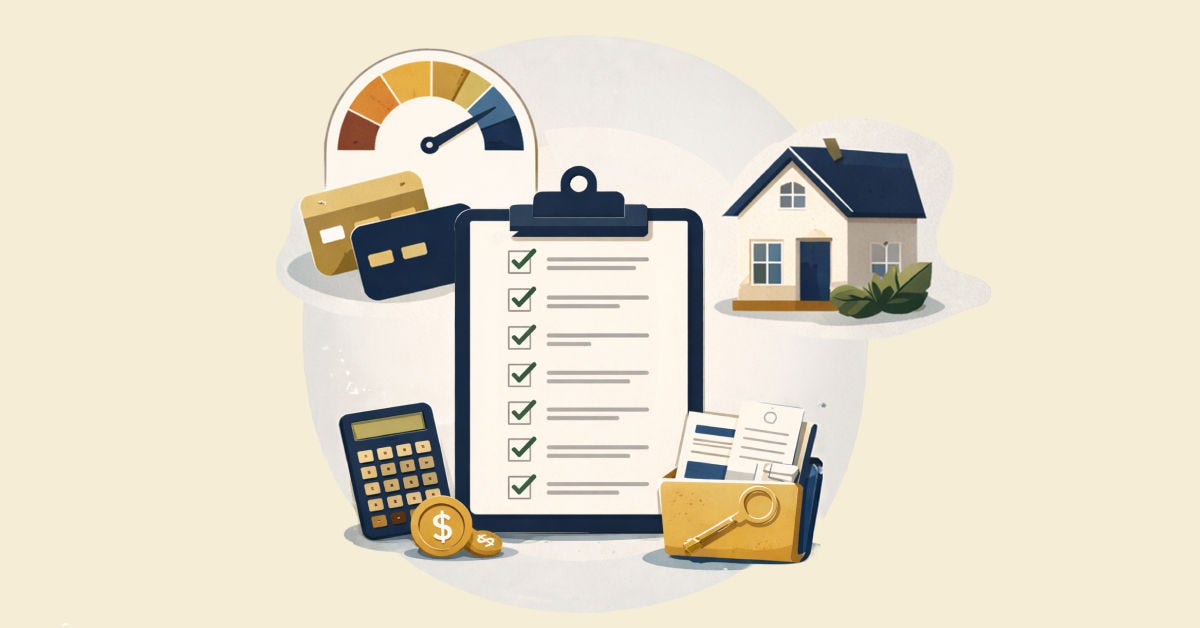
Before you apply for an $80,000 personal loan, consider this checklist of documents to have on hand for a smoother, faster process:
- Government-issued ID: Driver’s license, state ID, or passport—and your Social Security number
- Proof of address: Lease agreement, mortgage statement, utility bill, or bank statement
- Income documentation: Recent pay stubs and W-2s for salaried employees; tax returns, 1099s, and bank statements for self-employed or variable-income borrowers
- Debt details (if consolidating): Creditor names, account numbers, current balances, and monthly payments for any debts you plan to pay off
- Bank account information: Routing and account numbers for loan funding and autopay setup
How a co-borrower can help
Adding a co-borrower combines both applicants' monthly incomes and debt obligations into a single DTI ratio calculation. If your individual DTI ratio is borderline or your income alone doesn't comfortably support the payment, a co-borrower with strong credit and stable income can improve both your approval odds and the APR you're offered.
Some loan providers, including BHG Financial, allow you to add a co-borrower at the start of the application or during the process, so it's worth exploring before you apply solo.
See your offer † real fast
Just a few easy steps to get prequalified!
† This is not a guaranteed offer of credit and is subject to credit approval.
How to apply for an $80,000 personal loan
For qualified borrowers, applying for an $80,000 personal loan is straightforward, often with minimal documentation and quick funding. Here’s what you can expect.
1. Prequalify without impacting your credit
Once you find lenders that offer $80,000 personal loans and have requirements you can meet, start with a soft-pull personal loan prequalification. This lets you see estimated rates, terms, and payment amounts based on your financial profile without triggering a hard inquiry on your credit report, which can temporarily hurt your credit score.
Prequalification is the lowest-risk way to compare options and confirm that an $80,000 loan is available to you before you commit to a full application. You can then compare rate and term offers between lenders to figure out which works the best for you.
2. Choose your loan structure
Once you have rate estimates, decide on the term and monthly payment that fit your budget and goals. Use the payment scenarios above to model how different APRs and repayment terms affect both your monthly obligation and total interest paid. If you're consolidating debt, compare the new rate against your current APR across balances.
3. Upload documents and complete verification
After selecting the right lender and loan, you'll fill out the official application and submit the requested documentation. This typically includes income verification, identity documents, and debt details if you're consolidating.
Lenders processing large unsecured loans may request additional verification, so having everything organized in advance reduces back-and-forth delays. Closely communicate with your lender to ensure you submit everything requested.
4. Receive final approval and funding
Final approval involves a hard credit inquiry, which is standard across lenders and typically occurs at the funding stage. Once you get approved and sign the loan agreement, the lender generally disburses your funds in a lump sum, either to your bank account directly or to other creditors you’re paying off.
While timelines vary by lender, some can fund in as few as five business days, subject to approval and timely verification.
5. Set up autopay and begin repayment
Enroll in autopay immediately after receiving your funds. Many lenders offer a rate discount for doing so, and it eliminates the risk that a missed payment will hurt your credit.
If your cash flow allows, making occasional extra principal payments can reduce the total interest paid without triggering prepayment penalties through most lenders. But confirm with the lender that the extra funds will go toward lowering the principal and not your next regular payment.
How an $80,000 personal loan compares to alternatives
While an $80,000 personal loan is a flexible option for large expenses, you might want to consider alternatives if you don’t qualify or have unique needs. Below are four alternatives and their key differences from unsecured personal loans.
|
|
Rate type |
Collateral |
Funding speed |
|---|---|---|---|
|
Unsecured personal loan |
Fixed (typical) |
None |
Days |
|
HELOC |
Variable (typical) |
Home |
2–6 weeks |
|
Home equity loan |
Fixed (typical) |
Home |
2–6 weeks |
|
0% balance transfer |
Fixed promo rate, then variable |
None |
Days |
|
Secured personal loan |
Fixed or variable |
Asset (vehicle, savings, home fixtures) |
Varies |
Sources: Investopedia; Experian
HELOC
A HELOC gives you a credit line to use over a draw period (often five to 10 years), initially with interest-only payments. After that, you make full interest and principal payments over a repayment term that often runs 10 to 20 years. This can be ideal if you prefer smaller initial payments or are unsure how much you need to borrow.
But while HELOC APRs may be lower than those of unsecured personal loans, they’re usually not fixed, so your payments and costs may increase. Funding can take weeks; your home will be used as collateral; and closing costs of 2% to 5% of the borrowed amount can apply. Plus, you must have sufficient home equity to qualify.
Home equity loan
A home equity loan provides a lump sum at closing and usually has a fixed rate, which may be lower than for personal loans. This also means your payments are predictable and start at the full amount after closing.
However, like a HELOC, a home equity loan puts your home at risk and involves a more extensive application process and longer funding time than most personal loans. Closing costs can also increase your total costs.
0% balance transfer
A 0% balance transfer offer typically involves opening a new credit card account, selecting eligible debts to transfer, paying a 3% to 5% balance transfer fee, and having 12 to 21 months to repay the balance without interest charges. No collateral is needed.
While this can work well for smaller revolving balances that you can realistically pay off before the promotional period ends, it can be a costly option if you don’t. The average credit card rate is 21%—almost double the average personal loan APR.
Secured personal loan
A secured personal loan works much like an unsecured one, except that you must pledge some collateral. While this can improve your approval odds or lower your APR, your collateral will be at risk if you miss payments. Plus, approval can take longer since the lender needs to value and verify your asset.
Why choose BHG Financial for an $80,0001 personal loan
Whether you’re consolidating debt or funding home renovations, an unsecured personal loan is the fastest path to a fixed, predictable payment with no asset on the line.
BHG Financial offers large personal loans up to $250,0001 with fixed rates, predictable payments, and extended repayment terms up to 10 years.1,2 Our unsecured personal loans offer the flexibility to structure a budget-friendly payment that can meaningfully improve cash flow for high earners managing multiple financial obligations.
Built for people with complex financial profiles, BHG Financial’s underwriting process considers multiple income streams, which matters for those whose compensation includes bonuses, distributions, or self-employment income. Our U.S.-based loan specialists guide you through the process, and approval decisions can come in as little as 24 hours, with funding in as few as five days.3
Prequalification allows you to check your rate with no impact on your credit score4 and no application fees. Interested in learning more? Get a quick and easy estimate today.
Fortune’s top pick for large loans
Explore unsecured personal loan options up to $250K†
† Terms subject to credit approval upon completion of an application. Loan sizes, interest rates, and loan terms vary based on the applicant's credit profile. Not all applicants will qualify for the lowest rate.
$80,000 personal loan FAQs
Can you get an $80,000 personal loan?
An $80,000 personal loan is available as an unsecured loan, but not from every lender. Many mainstream lenders cap personal loans at $40,000 to $60,000, so you need to focus on lenders with maximum limits of $100,000 or higher. You’ll also need to have strong credit, a manageable DTI ratio, and a stable income to qualify.
How hard is it to get an unsecured $80,000 personal loan, and what credit score and income do lenders expect?
Getting approved for an $80,000 personal loan is more challenging than qualifying for a smaller amount because lenders take on more risk with no collateral backing the loan. You’ll typically need a credit score of at least 640. A higher score is ideal for the best rates. Your income must be verifiable and sufficient to keep your back-end DTI ratio below 36% to 40% after adding the new payment. Lenders also look at the depth of your credit file, your payment history, and how recently you've opened new accounts.
What fees and fine print should you check before accepting an $80,000 personal loan offer?
Before accepting any $80,000 loan offer, review the origination fee, which can range from 1% to 10% at some lenders and directly reduce the cash you receive while leaving the full principal on your repayment schedule. Check whether any rate discount is tied to autopay enrollment since canceling autopay later can increase your rate and monthly payment. Also, confirm whether there are prepayment penalties.
Recommended articles
Debt Consolidation
7 Key Factors That Determine Eligibility for High‑Limit Debt Consolidation Loans
January 12, 2026 | 7 min read
Debt Consolidation
Home Equity Loan vs. Personal Loan: Best Way to Pay Off Debt
June 23, 2026 | 10 min read
Personal Loans
Are Personal Loans a Good Idea for High Earners? What the Data Says
October 31, 2025 | 7 min read
Not all solutions, loan amounts, rates or terms are available in all states.
Advertised rates are subject to change without notice.
1 Terms subject to credit approval upon completion of an application. Loan sizes, interest rates, and loan terms vary based on the applicant's credit profile. Not all applicants will qualify for the lowest rate.
2 Personal Loan Repayment Example: A $60,000 personal loan with a 7-year term and an APR of 17.06% would require 84 monthly payments of $1,191.38.
3 This is not a guaranteed offer of credit and is subject to credit approval.
4 There is no impact on your credit for applying. For personal loans, a complete credit history, which will appear as an inquiry on your credit report, will be performed upon acceptance and funding of the loan and may impact your credit.
No application fees, commitment, or impact on personal credit to estimate your payment.
Consumer loans funded by Pinnacle Bank, a Tennessee bank, or County Bank. Equal Housing Lenders. 
For California Residents: Personal loans made or arranged pursuant to a California Financing Law license - Number 603G493.

Bankers Healthcare Group, LLC d/b/a BHG Financial NMLS ID# 2040829