
Personal loans
Customized financing to consolidate high-interest debt and unlock financial flexibility.
WAYS TO USE YOUR LOAN
Resources
Guides, insights, and research – explore our latest articles.
About BHG
Programs
How to Get a $60,000 Personal Loan
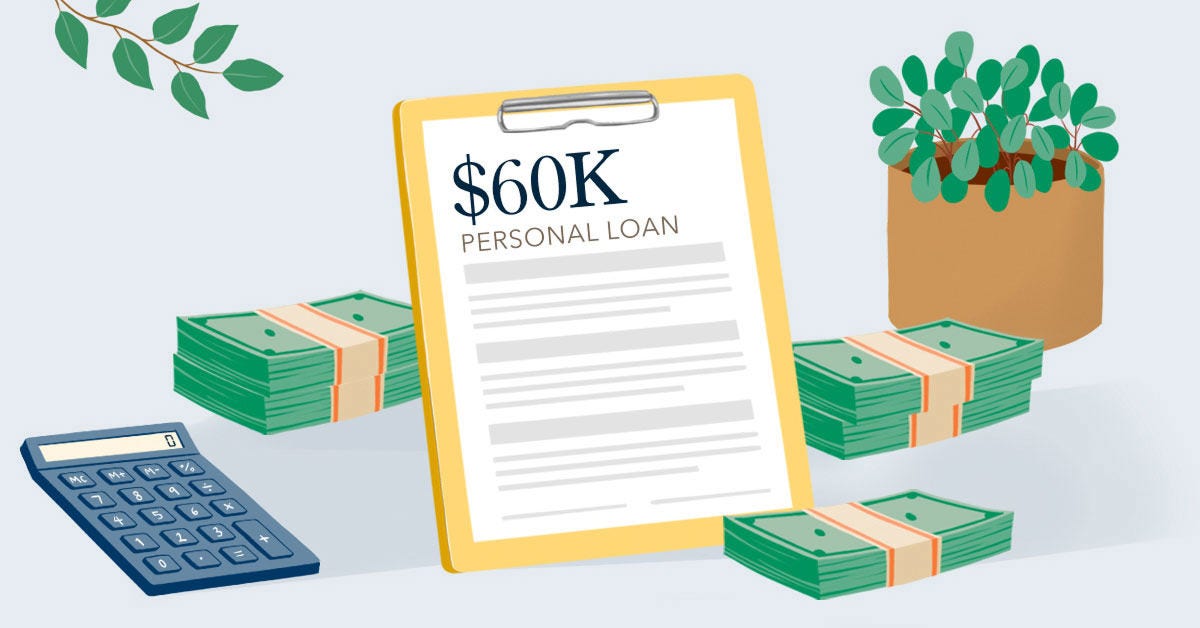
A $60,000 personal loan can cover a major expense without tapping your home equity or liquidating investments. But at this size, the cost of borrowing—and the qualification bar—both rise meaningfully.
This guide covers estimated payments on a $60,000 loan, what it takes to qualify, and whether it's the right move for your situation.
How much does a $60,000 personal loan cost?
A $60,000 personal installment loan typically costs between $7,687 and $69,733 in total interest, depending on your APR and repayment term.
A lower rate saves money over the life of the loan, but your credit profile determines what rate you qualify for. A longer loan term makes monthly payments more manageable, but you'll pay significantly more overall.
Neither choice is wrong; it depends on whether cash flow or total cost is your priority.
The table below shows estimated monthly payments and total interest for a $60,000 loan across common terms and APRs.
|
Term |
8% APR |
12% APR |
18% APR |
|---|---|---|---|
|
3 years |
$1,880/month |
$1,993/month |
$2,169/month |
|
5 years |
$1,217/month |
$1,335/month |
$1,524/month |
|
7 years |
$935/month |
$1,059/month |
$1,261/month |
|
10 years |
$728/month |
$861/month |
$1,081/month |
Image is a representative example for illustrative purposes only and does not reflect actual customer information.
See your offer † real fast
Just a few easy steps to get prequalified!
† This is not a guaranteed offer of credit and is subject to credit approval.
How to qualify for a $60,000 personal loan
At $60,000, lenders look more carefully at your full financial picture. This is a large personal loan, and underwriting reflects that. Here's what matters most.
Credit score and profile
Your credit score signals risk to lenders and directly influences the APR you're offered.
Lenders set different minimum income requirements, but in general, the higher your credit score, the lower your APR will be. Borrowers with scores above 740 typically see the most competitive rates.
Beyond the score itself, lenders review your full credit history. Recent delinquencies, high credit utilization, a short credit history, or multiple recent hard inquiries can all reduce your approval odds or push your rate higher, even if your score looks acceptable on the surface.
Income and debt-to-income (DTI)
Your debt-to-income ratio measures how much of your gross monthly income goes toward existing debt obligations. Lenders use it to evaluate whether you can comfortably absorb a new $60,000 loan payment.
For example, if you earn $10,000 per month before taxes and carry $2,500 in monthly debt obligations, your DTI is 25%. Adding a $60,000 loan at a 10-year term and 12% APR would add approximately $861 per month, pushing your DTI to roughly 34%.
Many lenders prefer a DTI under 36% for unsecured loans, though providers like BHG Financial are willing to consider applicants with higher DTIs when the broader financial profile, including income, credit history, and overall stability, comfortably supports it.
Documentation checklist for a large unsecured loan
For a $60,000 loan, expect to provide the following documentation:
- Government-issued photo ID and Social Security number
- Income verification: recent pay stubs and W-2s for salaried borrowers; two years of tax returns (including 1099s and K-1s) for self-employed or multi-income borrowers
- A list of current liabilities (monthly obligations, outstanding balances)
Having your documents ready before you apply can make the process significantly faster, especially if you're self-employed or have multiple income streams.
Is a $60,000 loan right for you?
A $60,000 unsecured loan is a significant financial commitment. Before applying, it's worth thinking through how the costs fit into your broader financial goals.
Longer terms lower payments but raise total interest
Longer terms create breathing room in your monthly budget, but if you can afford a shorter term, you'll pay significantly less over the life of the loan. Making occasional extra loan principal payments on a longer-term loan can also reduce total interest without locking you into a higher required monthly payment.
For example, a $60,000 loan at 12% APR costs $11,743 in total interest over three years. Stretch that to 10 years, and total interest climbs to $43,299—nearly four times as much—even though the monthly payment drops from $1,993 to $861.
Impact on DTI and future borrowing
Adding $60,000 in debt increases your monthly obligations and your DTI. This can affect your ability to qualify for a mortgage, auto loan, or business financing in the near term. If you're planning a major purchase within the next 12 to 24 months, factor that into your timing.
One way to mitigate this is by using the $60,000 as a debt consolidation loan to consolidate higher-rate revolving debt. Paying off credit card balances reduces your total monthly obligations and can actually lower your DTI while simplifying your payments.
Origination fees and net proceeds
Some lenders charge an origination fee that’s taken out of your loan proceeds. A 5% origination fee on a $60,000 loan means $3,000 is deducted upfront—you receive $57,000 but repay the full $60,000.
That fee is typically rolled into your APR, which is why comparing APRs across lenders (rather than stated interest rates) gives you a more accurate cost comparison.
Credit score effects
Applying for a new loan triggers a hard credit inquiry, which can temporarily lower your score by a few points. Over time, consistent on-time payments and reduced credit card utilization from debt consolidation can lead to positive credit score impacts.
Most borrowers who consolidate debt through BHG improve their FICO® score by 30 points or more within a few months of funding.*
Setting up autopay helps you stay on track with on-time payments, which can also help improve your credit score over time.
Most borrowers who consolidate debt through BHG improve their FICO score by 40 points or more within a few months of funding.*
$60,000 personal loan vs. alternatives
A well‑structured unsecured personal loan can provide liquidity without tying your financial future to a variable rate or a pledged asset. But it isn't the only way to access $60,000.
The right option depends on whether you own a home, how quickly you need funds, your risk tolerance, and your credit profile.
|
Feature |
Unsecured personal loan |
HELOC |
Home equity loan |
0% intro APR credit card |
|---|---|---|---|---|
|
Typical APR |
Varies by credit; fixed |
Variable; often lower |
Fixed; often lower |
0% intro (then 20%+) |
|
Collateral |
None |
Home equity |
Home equity |
None |
|
Speed to fund |
Days |
Weeks to months |
Weeks to months |
Days (card issuance) |
|
Fees |
Origination fee (varies) |
Closing costs (2%–5%) /span> |
Closing costs (2%–5%) |
Balance transfer fee (3%–5%) |
|
Risk |
Credit impact if missed |
Foreclosure risk |
Foreclosure risk |
Rate spike after intro |
|
Best for |
No collateral; fast funding; fixed payment |
Ongoing draws; homeowners |
Lump sum; homeowners |
Short-term payoff (<18 mo) |
Sources: Investopedia; Experian
Get a $60,0001 loan from BHG Financial
If you need $60,0001 without pledging collateral or waiting weeks to close, BHG Financial is one of the few lenders who can deliver.
Qualified applicants can access some of the largest unsecured personal loans available (up to $250,0001) with fixed rates and terms up to 10 years1,2, making it easier to balance monthly affordability with total cost.
Personal loan prequalification lets you check your rate in seconds3 without affecting your credit score,4 and you'll get an approval decision in as little as 24 hours.3
There are no application fees and no prepayment penalties if you want to pay off your loan early.
With 25+ years of lending history, more than $28+ billion in loans funded, over 4,000 five-star Trustpilot reviews, and an A+ BBB rating, BHG Financial is the preferred lender for large, unsecured loans.
Skip the home appraisal
Access personal loans up to $250K† without collateral
† Terms subject to credit approval upon completion of an application. Loan sizes, interest rates, and loan terms vary based on the applicant's credit profile. Not all applicants will qualify for the lowest rate.
Frequently asked questions (FAQs)
How hard is it to get a $60,000 personal loan?
Getting approved for a $60,000 personal loan is more demanding than qualifying for smaller amounts. Lenders typically tighten their requirements as loan size increases because the risk is higher.
At this level, most lenders want to see a credit score of at least 640, though scores in the good-to-exceptional range (670 and above) meaningfully improve both approval odds and the APR you're offered.
How fast can you get $60,000?
Funding for a $60,000 unsecured loan is fast, but same day is uncommon. Lenders need to verify your identity, confirm your income, validate your bank account, and complete fraud checks before releasing funds.
At BHG Financial, approval decisions can come in as little as 24 hours,3 and funds are available in as few as five days3 after approval.
Is a $60,000 personal loan better than a home equity loan or HELOC for the same amount?
Neither option is universally better, and the right choice depends on your situation. Home equity loans and HELOCs are secured by your home, which typically means lower APRs than unsecured personal loans.
However, they come with closing costs (often 2% to 5% of the loan amount), longer funding timelines (weeks to months), and the risk that your home serves as collateral. Missing payments on a secured loan can ultimately put your property at risk.
Recommended articles
Debt Consolidation
7 Key Factors That Determine Eligibility for High‑Limit Debt Consolidation Loans
January 12, 2026 | 7 min read

Personal Loans
How to Get a $100,000 Loan: Requirements, Rates, and Alternatives
May 23, 2025 | 8 min read
Personal Loans
Are Personal Loans a Good Idea for High Earners? What the Data Says
October 31, 2025 | 7 min read

Personal Loans
Should You Dip Into Savings or Use a Loan? How to Decide
October 14, 2025 | 6 min read
Debt Consolidation
When to Pay Credit Card Bill to Increase Credit Score
August 28, 2025 | 7 min read
Personal Loans
Personal Loan vs Credit Card: The Surprising Way to Cut Interest Costs
June 23, 2025 | 6 min read
Based on internal data, most BHG debt consolidation borrowers may improve their FICO® score by 30+ points within 2 months. Credit scores depend on many factors and individual results may vary based on personal spending habits.
Advertised rates are subject to change without notice.
Not all solutions, loan amounts, rates or terms are available in all states.
1 Terms subject to credit approval upon completion of an application. Loan sizes, interest rates, and loan terms vary based on the applicant's credit profile. Not all applicants will qualify for the lowest rate.
2 Personal Loan Repayment Example: A $60,000 personal loan with a 7-year term and an APR of 17.06% would require 84 monthly payments of $1,191.38.
3 This is not a guaranteed offer of credit and is subject to credit approval.
4 There is no impact on your credit for applying. For personal loans, a complete credit history, which will appear as an inquiry on your credit report, will be performed upon acceptance and funding of the loan and may impact your credit.
No application fees, commitment, or impact on personal credit to estimate your payment.
Consumer loans funded by Pinnacle Bank, a Tennessee bank, or County Bank. Equal Housing Lenders. 
For California Residents: Personal loans made or arranged pursuant to a California Financing Law license - Number 603G493.

Bankers Healthcare Group, LLC d/b/a BHG Financial NMLS ID# 2040829