
Personal loans
Customized financing to consolidate high-interest debt and unlock financial flexibility.
About BHG
Programs
Lower Your Debt-to-Income (DTI) Ratio Using Debt Consolidation
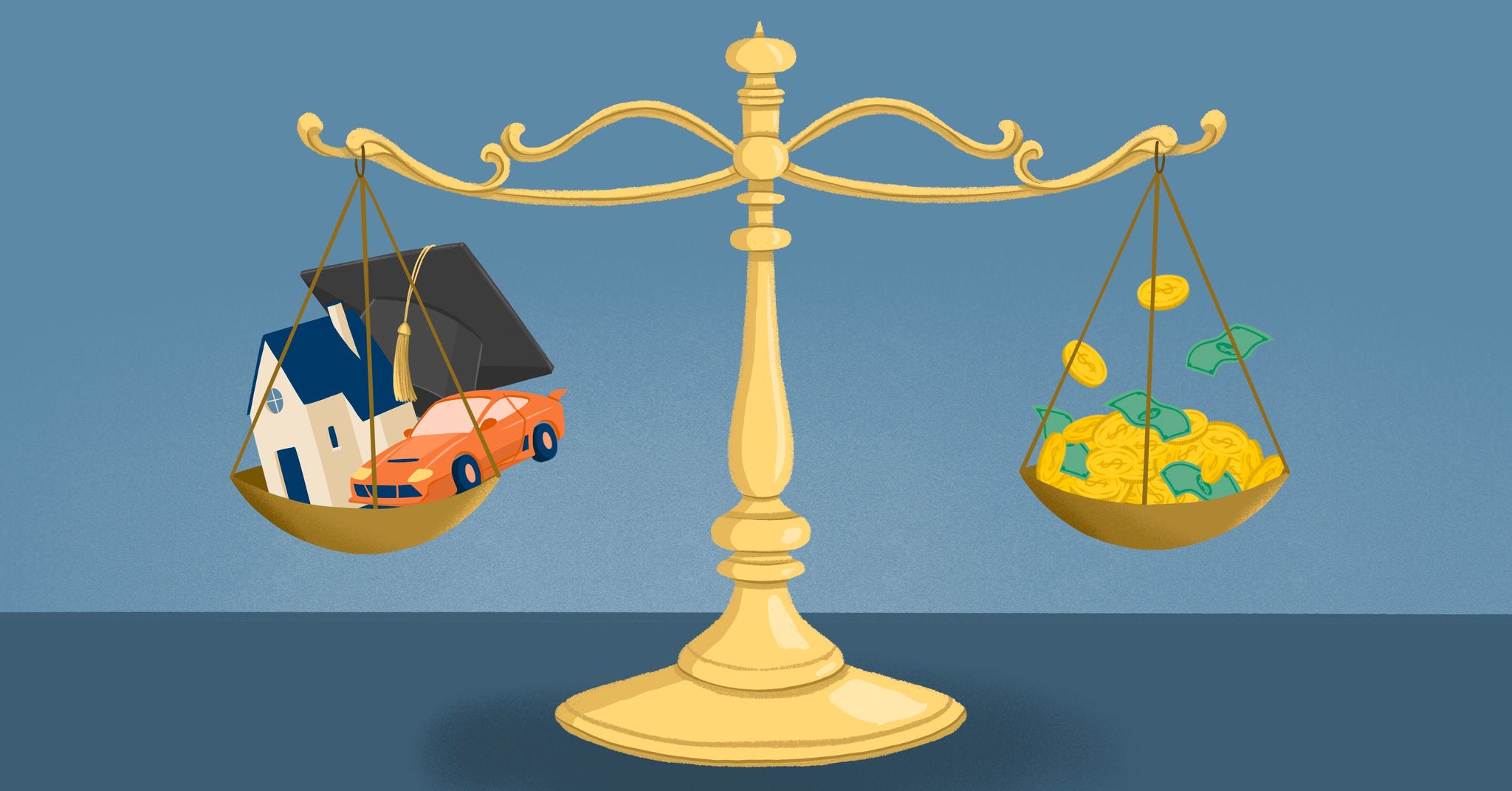
A lower debt-to-income (DTI) ratio can unlock better loan approvals, boost your negotiating power, and increase your monthly cash flow. One of the most direct ways to bring your DTI ratio down—without drastic lifestyle changes—is debt consolidation. This involves rolling multiple debts into one loan, leaving you with a single, manageable monthly payment.
Below, we'll discuss how to use debt consolidation strategically to lower your DTI ratio, including estimating the impact and assessing different consolidation options.
Key TAKEAWAYs
Consolidating debt can help you lower your DTI ratio since you’ll usually have a lower monthly payment. As a result, you might benefit from increased financial flexibility, better interest rates, and improved access to future credit. Choose your consolidation method carefully and take steps to maintain healthy financial habits for long-lasting results.
Understanding your DTI ratio
Your DTI ratio compares how much of your gross monthly income (before taxes) you use to cover your monthly debt payments. It helps lenders assess how comfortably you can manage your debt relative to your income.
According to the Federal Deposit Insurance Corporation, lenders may evaluate these two types of DTI ratios:
- Front-end DTI ratio: Also known as the “housing ratio,” this version is often used for mortgage approval. It compares only your monthly housing costs—including your principal, interest, insurance, taxes, and HOA fees—to your monthly gross income. Lenders typically recommend keeping this ratio at 28% or less.
- Back-end DTI ratio: More widely used by lenders and the focus of this article, the back-end ratio compares all monthly debt payments— such as your mortgage, auto loans, student loans, credit card minimum payments, and alimony/child support—to your monthly gross income. Limiting this ratio to 36% to 43% is considered ideal. However, some lenders (like BHG) might accept higher ratios, especially if you are a high earner.
Example: Imagine you have $20,000 in monthly gross income and $8,000 in monthly debt payments, of which $4,000 is your housing. While your front-end DTI ratio would be 20%, your back-end DTI ratio would be 40%.
Why lowering your DTI ratio matters
Here are some of the key benefits you gain from lowering your DTI ratio:
- Improved access to credit: Lenders favor extending credit to borrowers with back-end DTI ratios no higher than 50%, and the limit can be even lower if you’re applying for certain mortgage programs. A lower ratio allows you to qualify with more lenders, and for higher dollar loan amounts, versus a higher DTI.
- More competitive interest rates: Since a lower DTI ratio is a good thing when it comes to risk, lenders may be more willing to offer you lower interest rates on various types of loans and credit cards. These savings appear in both your monthly payment and your long-term borrowing costs.
- More financial flexibility: Allocating less income to debts frees up cash flow for other purposes and reduces your financial stress. Plus, as you make timely payments on your consolidated balance, you’ll reduce your credit utilization, which can improve your credit score and make achieving future financial goals easier.
How debt consolidation can improve your DTI ratio
Debt consolidation combines multiple balances into a single new loan—ideally with a lower interest rate or longer term. This process reduces your required monthly payment and, with it, your back-end DTI ratio.
Common ways to consolidate debts include:
- Taking out an unsecured personal loan
- Doing a credit card balance transfer (watch for 0% intro offers, transfer fees, and penalty APRs)
- Using home equity loans or HELOCs (secured by your home)
- Getting a credit union debt consolidation loan
Keep in mind, if your DTI ratio is already very high (often 50%+), you might have challenges getting approved and receiving favorable offers. Beyond that, extending a loan term lowers your monthly payment (and DTI ratio), but it can also increase the total interest paid over the life of your loan.
Take charge of your financial future
View prequalified loan offers and plan your next move
Steps for lowering your DTI ratio with a debt consolidation loan
Before consolidating debt to lower your DTI ratio, take time to better understand your current debt situation, review multiple consolidation options, and create a plan for the period after consolidation. Here are six steps that will guide you through the process.
1. Calculate your current DTI ratio
To calculate your current back-end DTI ratio, simply divide your total existing monthly debt payments by your gross monthly income. While you can use an online DTI ratio calculator for this, you can also do the math manually or use a spreadsheet.
To find your gross monthly income, total all the income you receive from your job, business, investments, and other sources. Review documents such as pay stubs, tax returns, bank and brokerage statements, employment contracts, and award letters. (Keep these handy, as lenders may require you to substantiate income using these documents during the approval process.)
When totaling your debts, don’t account for extra principal payments, utility bills, or any discretionary spending.
This quick worksheet can help you add up your debt payments:
|
Debt type |
Minimum monthly payment |
|---|---|
|
Mortgage/rent |
$X |
|
Home equity loan/HELOC |
$X |
|
Auto loan |
$X |
|
Student loan |
$X |
|
Personal loan |
$X |
|
Credit card |
$X |
|
Medical debt |
$X |
|
Personal line of credit |
$X |
|
Child support/alimony |
$X |
|
Other loans or credit lines |
$X |
|
Total debts |
$X |
2. Inventory your debts
Create a complete, accurate inventory of all the debts you want to consolidate. Use your loan documents and statements to identify and list the following details for each account:
- Lender name
- Account balance
- Repayment term remaining (if applicable)
- Minimum payment amount
- Due date
- Any promotional terms ending soon
3. Explore and compare debt consolidation options
Use the table below to compare different options for consolidating your debt:
|
Loan type |
Term length |
Rate |
Typical fees |
Secured? |
Considerations |
|---|---|---|---|---|---|
|
Unsecured personal loan |
24–120 months |
Often fixed; varies by credit profile (6% to 36%) |
Possible origination fee (often 1%–10%) |
Unsecured |
Strong credit, stable income, manageable DTI ratio |
|
Balance transfer card |
3–18 month intro period, but no fixed term |
0% intro APR for a limited period; then reverts to variable APR (usually 20%+) |
Transfer fee (typically 3%–5%) |
Unsecured |
Excellent credit; plan to repay the balance within the promo window |
|
Home equity loan/HELOC |
10–30 years |
Often lower than unsecured, but higher than a mortgage; fixed (loans), variable (HELOCs) |
Closing costs (typically 2%–5%); potential appraisal fees |
Secured by your home |
Sufficient equity; comfortable with collateral risk |
|
Cash out mortgage refinance |
10–30 years |
Standard mortgage rates; typically the lowest cost option |
Closing costs (typically 2%–5%); potential appraisal fees |
Secured by your home |
Relationship-based underwriting; rules vary by institution |
4. Model the impact of your consolidation scenarios
To know whether consolidating debt will meaningfully impact your DTI ratio and cash flow, go through some before-and-after scenarios. Let’s look at a simple example.
Before consolidation
Assume you start off with the following financial details:
Gross monthly income: $15,000
Current minimum payments
- Mortgage: $3,500 against a balance of $450,000
- Auto loan: $700 against a balance of $20,000
- Student loan: $500 against a balance of $25,000
- Credit cards: $1,200 against a balance of $35,000
- Personal loan: $1,000 against a balance of $15,000
Dividing your current minimum monthly debt payments ($6,900) by your monthly gross income ($15,000) results in a starting DTI ratio of 46%.
After consolidation
Imagine you decide to consolidate the $35,000 of credit card debt, and the $40,000 student and personal loans into a new fixed-rate $75,000 personal loan with 10% APR. This would give you a monthly payment of $1,245, cutting your current monthly payment on those debts in half.
After the transaction, your new monthly payment will be $5,445 of your $15,000 monthly gross income. This frees up $1,455 of your cash flow for other purposes.
Your new DTI ratio is now a more ideal 36% thanks to the lower payment amount.
5. Find a debt consolidation loan that works for you
If you find that debt consolidation is a good idea for improving your DTI ratio and financial flexibility, consider these factors to choose the best consolidation loan for your needs:
- Eligibility: You'll need to meet your lender’s debt consolidation loan requirements, including having a strong credit score, stable income, and an acceptable DTI ratio. Some consolidation options, such as HELOCs, home equity loans, and mortgages require having a minimum amount of equity in the property and meeting other rules.
- Loan amount: While borrowing the maximum loan amount may seem appealing, it can make your debt harder to manage and increase your costs. So, consider borrowing only what you need to consolidate your debt.
- Interest rates: While rate is not the most important aspect for lowering DTI, it does tell you the rough annual cost of borrowing. Research and compare rates for different lenders and consolidation options, including fixed versus variable rates, which can determine monthly payment predictability. A 1% rate increase on the $50,000 illustrative personal loan means a little less than $500 additional interest cost in the first year, or about $40 a month.
- Fees: Pay attention to balance transfer fees for credit cards, origination fees for personal loans, closing costs for home equity products, and credit union-specific fees for consolidation loans. Being able to finance the fees within the loan can save out of pocket costs, but increase lifetime interest and monthly payment. Also, check whether there are prepayment penalties, which the Consumer Financial Protection Bureau says aren’t allowed for specific loans in select states.
- Loan term: Term is the most important aspect of lowering DTI. Longer loan terms help lower your monthly payment, but can increase interest costs. You may be able to pay off your loan more quickly than the original term by making additional payments if your lender allows. Compare monthly payment amounts for different terms to find the right balance between affordability and interest savings.
- Funding speed: While BHG Financial offers prompt funding for its unsecured personal loans, other options that involve home equity can take several weeks or even months. Carefully consider the timing to benefit from consolidation as soon as possible.
Simplify your debt
Get prequalified fast and see your personal loan offers †
† This is not a guaranteed offer of credit and is subject to credit approval.
6. Maintain healthy financial habits after consolidation
Consolidating debt is just the starting point. Take the following steps to protect your progress, lower your DTI ratio, and keep your finances more manageable:
- Build up your emergency savings and use budgeting apps to stay on track, giving you a financial cushion so that unexpected expenses don’t derail your progress.
- Avoid new balances on paid-off accounts, so you don’t re-accumulate debt and raise your DTI ratio.
- Set up autopay so your positive payment history continues.
- Use a simple 50/30/20 budget to balance your needs, wants, and debt repayment/savings, keeping your spending aligned with your goals.
- Use the debt avalanche or snowball methods to direct extra cash to either the smallest balance (snowball) or the highest rate (avalanche) to accelerate payoff and reduce interest costs.
How BHG Financial’s debt consolidation loans can help lower your DTI ratio
For high-income professionals and business owners, BHG Financial offers tailored unsecured personal loans—up to $250,0001 with competitive rates and terms up to 101,2 years, all designed to lower your monthly payment and DTI ratio.
Our personalized solutions can address your complex financial needs so you can manage your debt effectively. Rather than juggling multiple monthly payments with varying interest rates, you’ll have a single, predictable monthly payment aligned with your budget and payoff goals. Plus, you’ll get dedicated support from our U.S.-based loan specialists.
If you’re ready to take the next step, start with our hassle-free qualification process, which won’t affect your credit score.3 You may be approved in as little as 24 hours4 and receive your funds in as few as 5 days. 4
Lower your DTI ratio with debt consolidation FAQs
What is a good DTI ratio to qualify for a personal loan?
Most lenders prefer a back-end DTI ratio under 36%, with some allowing up to 43% or 50%. Keeping your DTI ratio low increases your chances of getting approved for a personal loan at a competitive interest rate. However, some lenders (like BHG) might accept higher ratios, especially if you are a high earner.
How does debt consolidation affect my credit score?
If you pay down revolving accounts, you are likely to see a net increase in score. You may see a small, temporary dip from the new credit inquiry. However, credit scores consider high utilization of revolving debt to indicate higher risk, and therefore score customers with more revolving debt lower. If you are only consolidating term loans into another term loan, you will likely not see any benefit. However, improving your ability to make on-time payments can have a large impact over time, particularly if you have missed payments or defaulted on a loan in the past.
Can I qualify for a debt consolidation loan with a high DTI ratio?
If your DTI ratio is high, qualifying for a debt consolidation loan is possible but may be more challenging. Some lenders might limit approvals or offer higher rates, whereas other (like BHG) look at your larger financial picture and might accept higher ratios, especially if you are a high earner. Lowering your DTI ratio first may help improve your chances.
What are the risks of extending loan terms to lower monthly payments?
Longer terms reduce your monthly payments but if you only make minimum payments, your debt will remain outstanding longer, and therefore accrue more interest costs. Longer terms add flexibility, but require more discipline on your part to stay on track.
How long does it take to see improvements in my DTI ratio after consolidating debt?
Your DTI ratio can improve as soon as the consolidation loan funds and other debts are paid off. There will be more cash in your bank account each month, that you can direct to other objectives. The key is maintaining healthy habits, such as paying debts on time and avoiding adding new balances, so your progress sticks.
Check my rate
See your offer † real fast
Just a few easy steps to get prequalified!
† This is not a guaranteed offer of credit and is subject to credit approval.
Not all solutions, loan amounts, rates or terms are available in all states.
1 Terms subject to credit approval upon completion of an application. Loan sizes, interest rates, and loan terms vary based on the applicant's credit profile. Not all applicants will qualify for the lowest rate.
2 Personal Loan Repayment Example: A $60,000 personal loan with a 7-year term and an APR of 17.06% would require 84 monthly payments of $1,191.38.
3 There is no impact on your credit for applying. For personal loans, a complete credit history, which will appear as an inquiry on your credit report, will be performed upon acceptance and funding of the loan and may impact your credit.
4 This is not a guaranteed offer of credit and is subject to credit approval.
Consumer loans funded by Pinnacle Bank, a Tennessee bank, or County Bank. Equal Housing Lenders. 
No application fees, commitment, or impact on personal credit to estimate your payment.
For California Residents: Personal loans made or arranged pursuant to a California Financing Law license - Number 603G493.

Bankers Healthcare Group, LLC d/b/a BHG Financial NMLS ID# 2040829