
Personal loans
Customized financing to consolidate high-interest debt and unlock financial flexibility.
About BHG
Programs
How To Finance an ADU: Best Loan Options for Living Space Additions
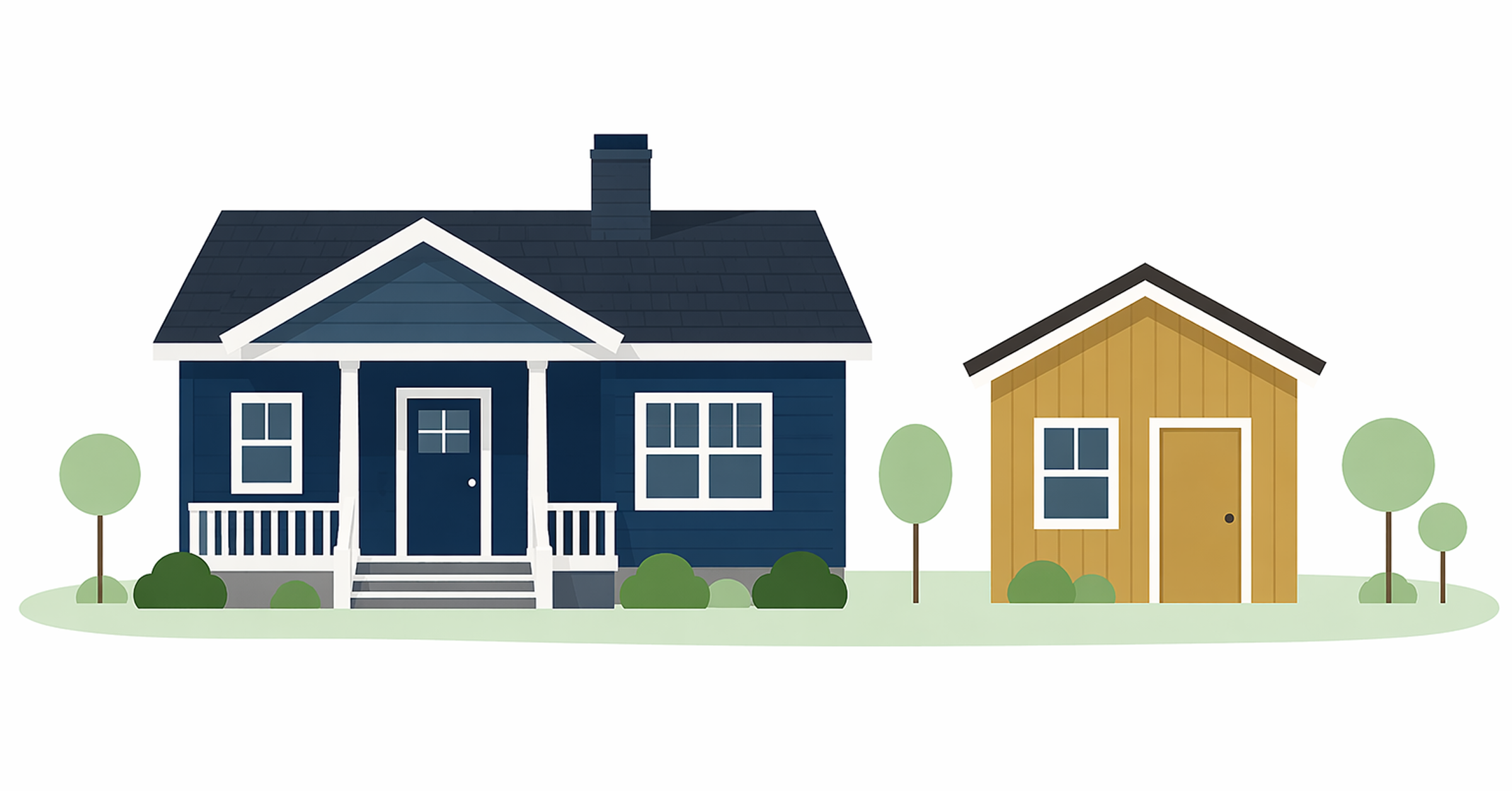
Adding an accessory dwelling unit (ADU) is often as much a financial decision as a personal one. Whether the goal is rental income, space for aging parents, or long-term property value, the right financing keeps your project on time and on budget.
In this guide, you'll learn how to finance an ADU, from equity-based loans to unsecured options. We cover costs, timelines, eligibility, and how lenders evaluate your plans, so you can choose with confidence.
How much does it cost to build an ADU?
An ADU is a self-contained living unit on the same lot as a primary residence, with its own entrance, kitchen, bathroom, and sleeping area. It can be a backyard cottage, an addition to your existing home, or a converted garage.
As a general benchmark, most ADU projects fall somewhere between $40,000 to $360,000, with costs rising for complex utility work or premium finishes. Basement and garage conversions tend to be the most affordable, while detached new construction sits at the higher end.
Beyond the flexibility it adds for multigenerational living, an ADU can increase your property value and generate meaningful rental income. In strong rental markets, monthly rent from an ADU can offset a significant share of your financing payment.
Some lenders will factor that rental potential into their underwriting, which can help you qualify for a larger loan amount.
Loan options to finance an ADU project
There’s no single best way to finance an ADU. The right fit depends on multiple factors, including your equity, credit, income, and risk tolerance.
Home equity loan
A home equity loan is a fixed-rate second mortgage that gives you a lump sum upfront with predictable monthly payments, often at lower rates than unsecured credit. Many lenders cap combined loan-to-value (CLTV) at 80% to 85%, so the more equity you've built, the more you can borrow.
Here's how the funding process works:
- Funds arrive at closing in a single lump sum, so you'll set up and manage payments directly with your contractors.
- Closing typically takes a few weeks and may include an appraisal, title work, and closing costs.
- Interest accrues on the full amount from day one since the entire balance is disbursed upfront.
- You pay the loan back over a pre-determined time period (often five to 30 years).
This option works best for ADU projects where you have a firm scope and budget. Because approval is based on your home's current appraised value—not what it will be worth once the ADU is built—you'll need enough equity to cover the full project before breaking ground.
Since your home is used as collateral, it’s important to consider the risks of home equity loans before moving forward.
Home equity line of credit (HELOC)
A HELOC is a revolving line of credit that lets you borrow against your home's equity—often up to 85% of your home's value minus what you owe on your mortgage.
During the draw period (which is typically 10 years), you pull funds as needed and pay interest only on what you've used. After that, you enter a repayment phase of up to 20 years.
This flexibility can make it a stronger fit for ADU projects than a lump-sum loan. Contractor deposits, inspections, utility hookups, and change orders can be covered as they come up, keeping interest costs lower early in the build.
The main trade-offs are rate risk and collateral. Since rates are variable, your payment can shift as market conditions change, which is important to consider for longer builds.
Your home also serves as collateral here, as it does with a home equity loan. Budgeting a cushion for potential rate increases is worth factoring in from the start.
Cash-out refinance
A cash-out refinance replaces your existing mortgage with a larger one and pays out the difference in cash. That gives you a single pool of funds to cover contractor deposits, materials, and progress payments as your ADU build moves forward.
You'll typically need at least 20% equity in your home to qualify, and many lenders will allow you to borrow up to 80% of your home's value. Lenders will also assess your credit and debt-to-income (DTI) ratio before setting a maximum cash-out amount. Closing costs typically run 2% to 6% of the loan amount, and the process follows a similar timeline to a standard mortgage refinance (usually 30 to 45 days).
This option works best when your current mortgage rate is high enough that refinancing makes sense on its own. In that case, you can fund the ADU build while potentially lowering your monthly payment at the same time.
If you're already locked into a low rate, replacing it to access cash could significantly increase your total interest costs over the life of the loan. One other consideration: Since your home serves as collateral, missing payments carries more risk than an unsecured loan.
Construction and renovation loans
Construction loans are short-term loans that fund new builds from the ground up. If you're adding a detached ADU in your backyard, for example, a construction loan could cover the full build.
Rather than a lump sum, the lender disburses funds at key milestones, such as foundation, framing, and finishing work. During construction, you pay interest only on the funds drawn to date. Down payment requirements vary, but some construction loans ask for as much as 20% at closing. Many convert to a permanent mortgage once the build is complete.
Renovation loans are a type of construction loan designed for improving an existing structure rather than building a new one. If you're converting an attached garage into an ADU, for instance, a renovation loan could be the right fit.
The key difference is how the loan amount is calculated. Renovation loans are based on your home's expected value after the project is finished, not its current value. For an ADU project where existing equity is limited, that distinction can increase how much you're able to borrow.
Both options have more requirements than a standard loan:
- Approved permits and plans from a licensed contractor before closing
- An itemized project budget reviewed and approved by the lender
- Staged inspections tied to each funding draw, which adds time to the process
- A credit score of at least 680 in many cases, along with a low debt-to-income ratio
The upside of that complexity is that you may qualify for more funding than a home equity loan or HELOC.
Unsecured personal loan for home improvement
An unsecured personal loan gives you a lump sum based on your credit, income, and ability to repay—no home equity or collateral required. You repay the loan in fixed monthly installments at a fixed rate (typically 6% to 36%), making it easy to budget and plan your ADU project.
Some lenders offer $100,000 personal loans, or higher (like BHG Financial), and funding can happen in a matter of days rather than weeks. A personal loan can be especially useful in the early stages—architectural plans, engineering, surveys, and permit fees are due long before a construction draw or refinance closes.
Compared to secured loans, an unsecured loan can move quickly without an appraisal or home valuation, helping you stay on schedule through design and permitting.
It can also bridge funding between contractor milestones or cover cost overruns without affecting your home title. Since these are fixed-rate loans with fixed payments, personal loans are easy to forecast cash flow while you prepare to rent the ADU or refinance later. Lastly, personal loan prequalification, available through premium lenders like BHG Financial, allows you to see your rates without impacting your credit score.
See your offer † real fast
Just a few easy steps to get prequalified!
† This is not a guaranteed offer of credit and is subject to credit approval.
How to choose the best way to finance your ADU
Financing an ADU isn't a one-size-fits-all decision. The right option depends on where you are financially and how you want to structure the project.
Before comparing loans, consider these four factors:
- How much equity you have and whether you're comfortable using your home as collateral
- How quickly you need funds—some options close in days, others take weeks
- Your ideal repayment timeline and whether a fixed or variable rate fits your budget
- The scope of your project: A firm budget favors a lump-sum loan, while phased costs may suit a line of credit.
From there, compare estimated payments, total costs including fees, and rate structure side by side.
|
Option |
Collateral |
Rate |
Funding speed |
Best for |
Tradeoff |
|---|---|---|---|---|---|
|
Home equity loan |
Home |
Fixed |
Moderate |
Fixed-scope projects with ample equity |
Home is collateral; interest accrues on full amount from day one |
|
HELOC |
Home |
Variable |
Moderate |
Phased/unpredictable costs |
Home is collateral; rates can shift as markets change |
|
Cash-out refinance |
Home |
Fixed or adjustable |
Moderate to slower |
Consolidating debt, large cash needs |
Home is collateral; closing costs of 2%–6% of loan amount |
|
Contruction/renovation loan |
Home |
Varies |
Slower (staged) |
New builds or improvements when equity is limited |
More documentation and inspections required |
|
Unsecured personal loan |
None |
Fixed |
Fast (often days) |
Speed, simplicity, and preserving home equity |
Rates may be higher than secured options |
Many successful ADU projects blend financing types. Pairing a HELOC for construction draws with a personal loan for design, permits, or contingencies, for example, combines fixed and variable interest rates in a way that balances flexibility with predictability.
If speed, predictable payments, and keeping your home unencumbered are priorities, a personal loan for home improvements through BHG Financial is worth considering.
How BHG Financial can finance your next ADU project
An ADU project moves in phases—and so do the costs. Whether you’re building a rental ADU or adding space for aging parents, expenses arrive before most secured loans even close.
A personal loan or home improvement loan through BHG Financial can cover those early costs, then carry you through the full build with predictable, fixed monthly payments.
Loan amounts go up to $250,000,1 with repayment terms up to 10 years.1,2 That combination of borrowing power and flexible terms means you can keep monthly payments manageable while the ADU generates rental income or simply adds value to your property.
Check my rate
See your offer † real fast
Just a few easy steps to get prequalified!
† This is not a guaranteed offer of credit and is subject to credit approval.
Not all solutions, loan amounts, rates or terms are available in all states.
1 Terms subject to credit approval upon completion of an application. Loan sizes, interest rates, and loan terms vary based on the applicant's credit profile. Not all applicants will qualify for the lowest rate.
2 Personal Loan Repayment Example: A $60,000 personal loan with a 7-year term and an APR of 17.06% would require 84 monthly payments of $1,191.38.
No application fees, commitment, or impact on personal credit to estimate your payment.
Consumer loans funded by Pinnacle Bank, a Tennessee bank, or County Bank. Equal Housing Lenders. 
For California Residents: Personal loans made or arranged pursuant to a California Financing Law license - Number 603G493.

Bankers Healthcare Group, LLC d/b/a BHG Financial NMLS ID# 2040829