
Personal loans
Customized financing to consolidate high-interest debt and unlock financial flexibility.
About BHG
Programs
How to Get a Loan to Build an ADU
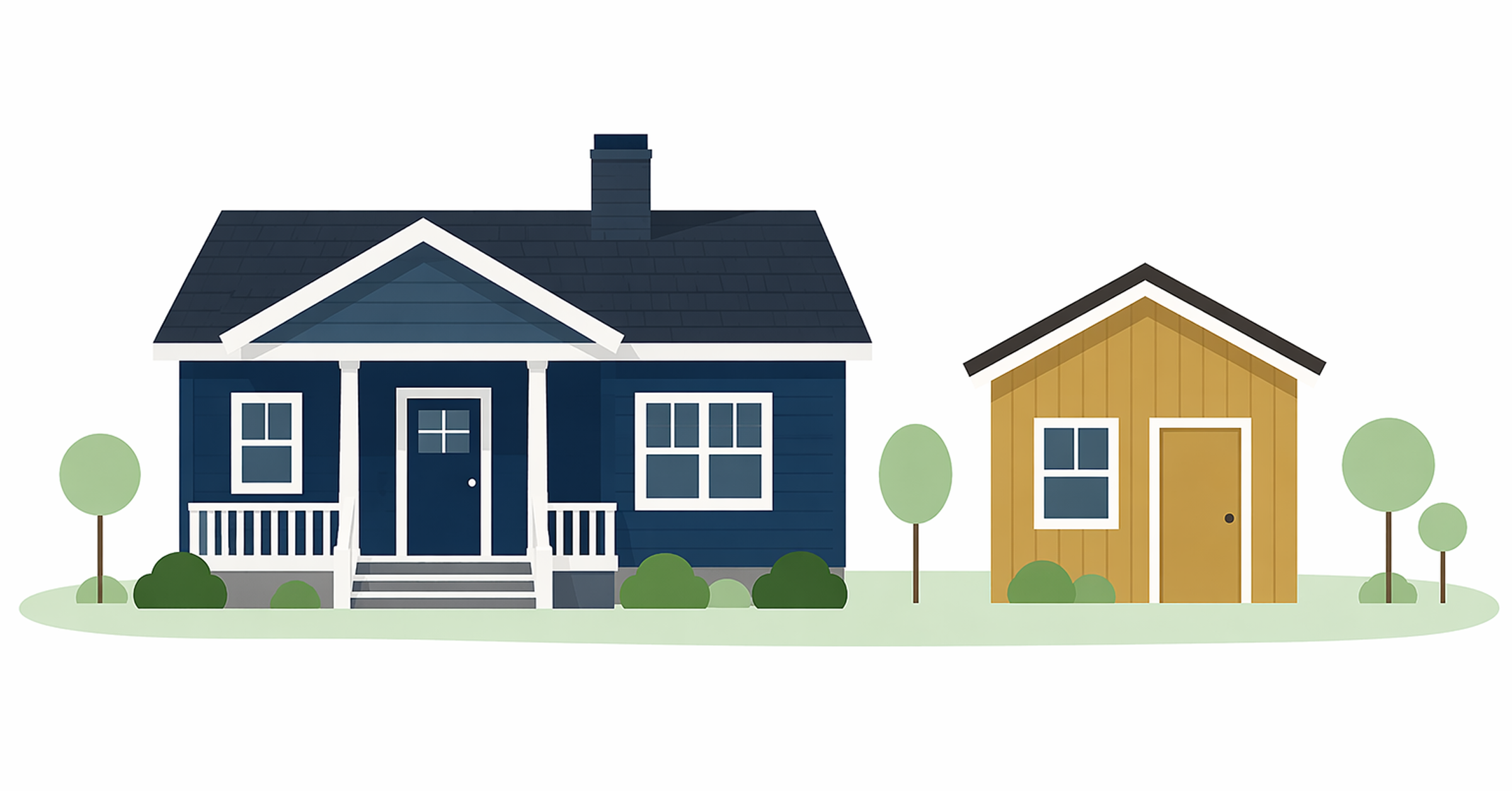
Building an ADU can be a smart investment, but it’s also a significant expense. Because of this, many high earners prefer financing an ADU rather than tapping into savings or investments.
The good news is that you have multiple options for funding an ADU, from unsecured personal loans and home equity products to renovation mortgages.
The right fit depends on multiple factors, including:
- Your equity position
- Credit profile
- Debt-to-income ratio (DTI)
- How quickly you need to break ground
In this guide, you’ll learn how to get a loan to build an ADU that fits your needs and financial profile. We cover the top options, when each one is right for different scenarios, and the financial benefits of adding an ADU to your home.
What is ADU financing?
ADU financing refers to any loan product used to fund the design, permitting, and construction of an accessory dwelling unit, or ADU. ADUs are secondary living spaces on a residential property, such as a detached backyard cottage, a converted garage, or an attached in-law suite.
There are three main ways to finance an ADU:
- Unsecured personal loans (no collateral required)
- Equity-based products that draw on your home's existing value
- Renovation or construction loans underwritten to the property's projected value once the ADU is complete
The average range for building an ADU is $40,000 to $360,000, but the total cost depends on size, location, construction type, and other factors. Since ADU financing can affect your monthly cash flow, equity risk, and overall project cost, it’s important to understand the pros and cons of each option.
ADU financing options
Not every ADU loan works for every project. Some options draw on your home's equity, others require no collateral, and a few are designed specifically for new construction.
Here's an overview of your options.
1. Unsecured personal loan
An unsecured personal loan provides a fixed lump sum with no collateral required, meaning your home isn’t on the line.
Because there's no collateral involved, qualification is based on your credit profile, income, and debt-to-income ratio rather than your home's equity. That also means the application process is often faster and less documentation-heavy than equity-based products.
The trade-off is that interest rates are often higher, ranging from 6% to 36%, depending on where you qualify. That said, for borrowers who want to preserve their home equity or avoid replacing a low existing mortgage rate, it may be worth it.
For home renovations specifically, the high loan amounts available through some lenders make this an appealing option. For example, BHG Financial offers access to personal loans for home renovations up to $250,000,1 with terms up to 10 years.1,2 Extended terms help keep monthly payments low—an indisputable benefit for homeowners who want to protect cash flow.
Large loan requirements above $100,000 usually require a score of 700 or higher. The maximum personal loan amount you qualify for is based on your overall financial profile, but lenders like BHG will consider higher DTIs when income and financial history support it.
See your offer † real fast
Just a few easy steps to get prequalified!
† This is not a guaranteed offer of credit and is subject to credit approval.
2. Home equity line of credit (HELOC)
A HELOC is a revolving credit line secured by your home's equity, similar in structure to a credit card with a draw period followed by a repayment period.
During the draw period, which is generally 10 years, you borrow what you need, when you need it, and pay interest only on the outstanding balance. Repayment of principal begins when the draw period closes.
HELOCs are best for phased ADU builds where costs arrive in stages, and you want flexibility to draw funds incrementally. If you're weighing HELOC versus personal loan options for an ADU project, the right choice often comes down to how much equity you have and whether you want fixed payments or a revolving line.
Most lenders cap combined loan-to-value ratio (CLTV) at around 85%, and rates are typically variable, meaning your payment can shift as market rates change. Lenders can also reduce or suspend your credit line if your home's value drops significantly, which could limit your access to funds mid-project.
3. Home equity loan
A home equity loan delivers a fixed lump sum at a fixed interest rate, repaid in equal monthly installments over a set term (often five to 30 years). Unlike a HELOC, the rate and payment don't change, which simplifies budgeting.
Home equity loans are ideal for borrowers who know their total ADU cost upfront and desire payment predictability. With this form of financing, if construction costs exceed your initial estimate, you'll need a separate source of funds to cover the gap.
Typical eligibility requirements include:
- Credit score: 620 or higher
- DTI: Typically 50% or lower
- Remaining equity: At least 15%–20% after the loan closes
Your home serves as collateral with this type of loan, which is one of the major disadvantages of home equity loans. If that’s a concern, other financing paths may be a better fit.
4. Cash-out refinance
A cash-out refinance replaces your existing first mortgage with a new, larger mortgage and pays the difference in cash. If your home has appreciated significantly, this can unlock a substantial lump sum.
To qualify, you'll generally need at least 20% equity, and most lenders will let you borrow against up to 80% of your home's value. Factor in closing costs, which generally fall between 2% and 6% of the loan amount, and a longer timeline for funding—roughly 30 to 45 days.
This option is well-suited for homeowners with strong credit and a current mortgage rate that isn't significantly higher than today's rates.
Refinancing resets your mortgage term and, if current rates are higher than your existing rate, increases your long-term interest cost. Run the numbers carefully before trading a low-rate first mortgage for a higher one.
5. Construction-to-permanent loan
A construction-to-permanent loan funds the build in stages—called draws—as work is completed and inspected, then converts to a standard mortgage once construction wraps up.
Some conventional loan programs explicitly support new construction that includes an ADU, so it's worth confirming with your lender whether your project qualifies.
This type of loan works well for ground-up ADU builds on properties without an existing structure, or new construction where the ADU is part of the original build.
Qualification is also notably more involved than a standard mortgage. Lenders typically require a credit score of 680 or higher, detailed construction plans, a purchase contract, an appraisal, and a vetted builder. If you're adding an ADU to an existing home rather than building new, renovation loans are usually a simpler path.
How to choose the right ADU loan
Every ADU project has a different budget, timeline, and risk tolerance. The financing option that works for a $60,000 garage conversion won't necessarily fit a $300,000 detached build.
Here's a quick guide to matching your situation with the right loan type.
|
Loan type |
Amount |
Typical term |
Common APR range |
|---|---|---|---|
|
Unsecured personal loan |
up to $250,000 |
2 to 10 years |
11% to 15% for prime borrowers |
|
HELOC |
$25,000–$250,000+ (equity dependent) |
10-year draw; 10–20-year repayment |
Variable (around 9%) |
|
Home equity loan |
$25,000–$250,000+ (equity dependent) |
5 to 30 years |
7% to 9% |
|
Cash-out refinance |
$25,000–$250,000+ (equity dependent) |
15 to 30 years |
Mortgage-rate dependent |
When an unsecured personal loan makes sense
Speed and flexibility are the defining advantages of an unsecured personal loan. It's also the right tool when you want to avoid touching your home equity or when your existing mortgage rate is low enough that refinancing doesn't make financial sense.
Repayment predictability can also help keep your finances easy to manage during a renovation.
See your offer † real fast
Just a few easy steps to get prequalified!
† This is not a guaranteed offer of credit and is subject to credit approval.
When a HELOC or home equity loan makes sense
If you've built meaningful equity in your home—typically enough to keep your CLTV at or below 80% to 85% after borrowing—a home equity product is often the most cost-effective path.
A HELOC suits phased projects where costs arrive in stages, while a home equity loan works better when you have a firm budget and want a fixed monthly payment from the start.
Both options preserve your existing first-mortgage rate, which matters if you locked in a low rate in prior years.
When a cash-out refinance makes sense
A cash-out refinance is worth considering when your current mortgage rate is close to or above today's prevailing rates, your home has appreciated substantially, and you want to consolidate everything into one payment.
It's less attractive when refinancing would meaningfully increase your rate on a large existing balance—the interest cost over time can outweigh the convenience.
When a construction-to-permanent loan makes sense
If you're building a new primary residence that will include an ADU from the ground up, a construction-to-permanent loan is purpose-built for that scenario. It's less practical for adding an ADU to an existing home, where renovation loans are usually the better fit.
Benefits of financing and building an ADU
Beyond the upfront cost, an ADU can strengthen your financial position in several ways. Here's what to consider as you evaluate whether the investment makes sense.
Support multigenerational living
Many Americans in their peak earning years are part of the sandwich generation, balancing care for aging parents while still helping adult children establish themselves. An ADU can make multigenerational living more practical by creating a private, on‑site space for family members without forcing a move or shared living arrangements.
Financing an ADU allows homeowners to meet these responsibilities while preserving cash flow and long‑term financial stability.
Create rental income
A permitted ADU can generate monthly rental income without requiring a separate property purchase. Keep in mind that rental income potential varies by location, unit size, and local market conditions, so it's worth verifying realistic rent ranges with a local appraiser or property manager before breaking ground.
Lenders also treat projected ADU rental income differently depending on the loan program, so confirm eligibility with your lender before counting on it for qualification.
Increase property utility and potential value
An ADU adds usable square footage and a separate living unit to your property, both of which can improve appraised value.
The actual value increase depends on local comparable sales, buyer demand for ADU-equipped properties, and the quality of the build. An as-completed appraisal will give you the most accurate picture of projected value improvement before you commit to a loan.
Preserve cash and liquidity
Financing an ADU rather than paying cash preserves your liquid reserves for emergencies, investment opportunities, or operating expenses.
Fixed-rate loan products provide predictable monthly payments that simplify cash flow planning, whether you go with a personal loan, home equity loan, or renovation mortgage. For borrowers deciding between loans or savings, preserving liquidity can be a major reason to finance an ADU rather than pay entirely out of pocket.
Maintain your existing first-mortgage rate
If your current mortgage carries a rate significantly below today's market, a cash-out refinance would replace that rate with a higher one across your entire remaining balance.
Second-lien products like HELOCs and home equity loans, as well as unsecured personal loans, leave your first mortgage untouched. For many homeowners, this consideration alone determines which financing path makes the most sense.
How BHG Financial can finance your ADU build
If you want to finance your ADU without putting your home on the line, BHG Financial offers access to some of the highest loan amounts and longest personal loan terms on the market. Through BHG, you can get unsecured personal loans up to $250,0001 with fixed rates and extended terms up to 10 years.1,2
There's no collateral required and no prepayment penalty if you want to pay off the balance early.
BHG is built for six-figure professionals and business owners with complex financial profiles, whether you're funding the full build or combining your ADU project with other objectives, such as debt consolidation. Approval decisions come in as little as 24 hours, with funding in as few as five days.3
Check your loan options today, with no impact to your credit score.4
Check my rate
See your offer † real fast
Just a few easy steps to get prequalified!
† This is not a guaranteed offer of credit and is subject to credit approval.
Frequently asked questions (FAQs)
What is the best loan to build an ADU?
The best loan to build an ADU depends on your equity position, timeline, and how much risk you're comfortable taking on.
If you have significant home equity, a HELOC or home equity loan is often the most cost-effective route. Don’t want to use your home as collateral? An unsecured personal loan could be the better option.
How do you get a loan to build an ADU?
Start by confirming your ADU can be legally permitted in your area. Then choose a financing type—personal loan, HELOC, home equity loan, construction-to-permanent, or renovation mortgage—based on your equity and timeline.
You'll need to gather standard financial documents like proof of income, assets, and existing mortgage details, plus ADU-specific items like architectural plans, permits or permit-ready drawings, and contractor estimates, depending on the loan.
How much does it cost to build an ADU?
The cost to build an ADU ranges from $40,000 to $360,000, depending on size, site conditions, utility connections, design complexity, and local permitting requirements. Costs may increase for larger builds that require foundation work and framing, but it’s also important to factor in soft costs like architecture, engineering, and inspections.
What are the disadvantages of ADUs?
Common disadvantages of ADUs include higher upfront costs than many homeowners expect (especially utilities and permitting), longer timelines due to design and approvals, and ongoing responsibilities if you rent the unit (maintenance, tenant management, insurance).
ADUs can also reduce privacy and yard space, and some properties face constraints like limited parking, utility capacity, or setback rules that increase complexity.
Not all solutions, loan amounts, rates or terms are available in all states.
1 Terms subject to credit approval upon completion of an application. Loan sizes, interest rates, and loan terms vary based on the applicant's credit profile. Not all applicants will qualify for the lowest rate.
2 Personal Loan Repayment Example: A $60,000 personal loan with a 7-year term and an APR of 17.06% would require 84 monthly payments of $1,191.38.
3 This is not a guaranteed offer of credit and is subject to credit approval.
4 There is no impact on your credit for applying. For personal loans, a complete credit history, which will appear as an inquiry on your credit report, will be performed upon acceptance and funding of the loan and may impact your credit.
No application fees, commitment, or impact on personal credit to estimate your payment.
Consumer loans funded by Pinnacle Bank, a Tennessee bank, or County Bank. Equal Housing Lenders. 
For California Residents: Personal loans made or arranged pursuant to a California Financing Law license - Number 603G493.

Bankers Healthcare Group, LLC d/b/a BHG Financial NMLS ID# 2040829